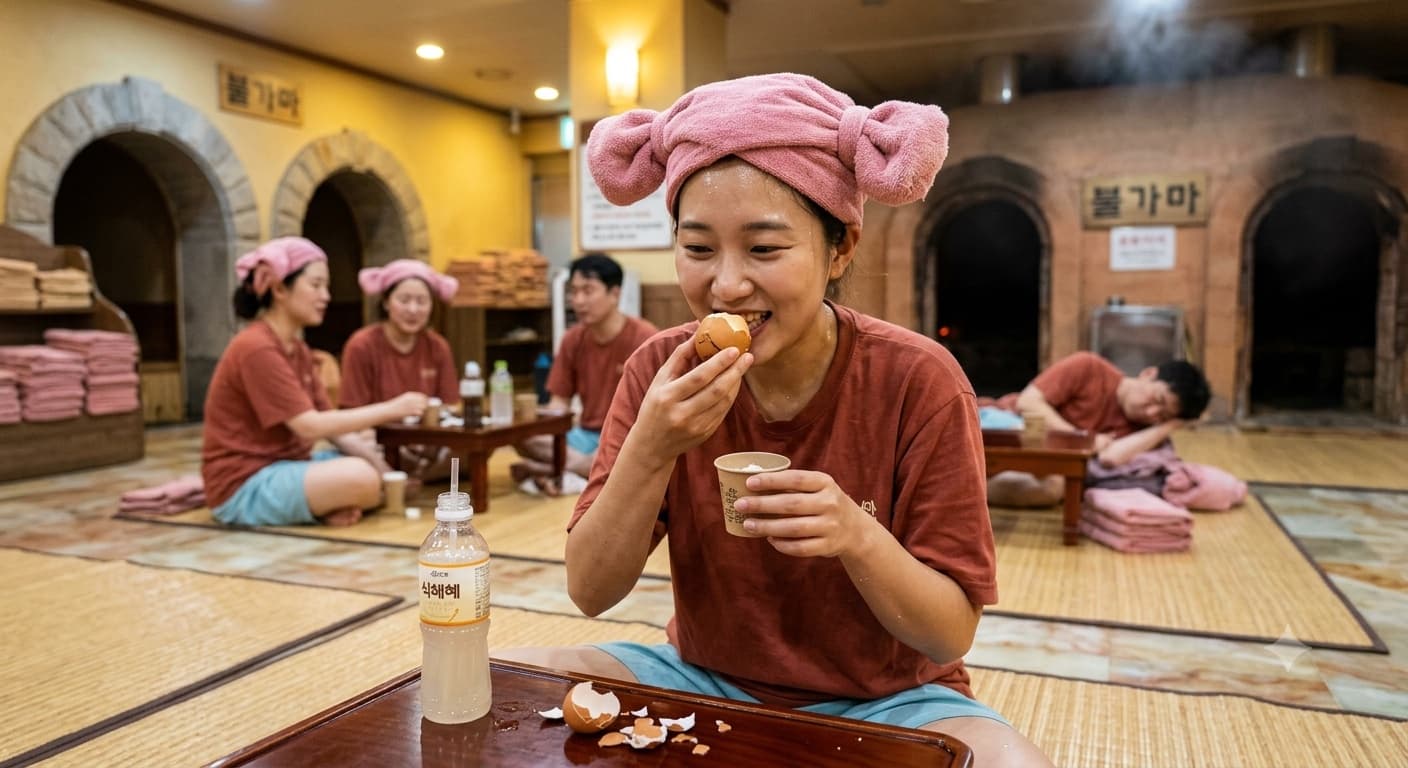
Every K-drama has the scene: characters in matching cotton pajamas, towels folded into little horns on their heads, cracking eggs on each other's foreheads in a big heated hall. That's a jjimjilbang (찜질방) — Korea's 24-hour bathhouse-sauna complex — and it's one of the most complete cultural experiences the country offers for the price of a movie ticket.
It's also the experience visitors most often chicken out of, almost always for the same reason: the bath hall is nude, and nobody explains the rules. So here are the rules — all of them.
What a jjimjilbang actually is
Two zones, one building:
- The bath zone (mogyoktang, 목욕탕) — sex-segregated, fully nude. Rows of showers, soaking tubs at different temperatures, saunas, and the famous scrub stations.
- The common zone (jjimjilbang proper) — mixed-gender, everyone in the facility-issued shorts and T-shirt. This is the big floor with themed sauna rooms (salt, charcoal, ice), heated floors to nap on, snack bars, massage chairs, and — in the big ones — karaoke, PC corners, and sleeping rooms.
The cultural logic: it's less "spa day" than public living room. Families spend Sunday afternoons here, students study here, night-shift workers and late travelers sleep here (24-hour entry usually includes overnight stays — it's Korea's classic budget accommodation hack).
Worth being clear, though: not every Korean is a bathhouse regular. Public baths were once a necessity — many older homes lacked proper bathrooms — but that era is long gone, and plenty of Koreans today, especially younger ones, visit rarely or not at all. What keeps the jjimjilbang alive isn't need; it's that it's genuinely fun. It survives as a leisure destination because of the sheer variety packed under one roof — hot rooms and cold plunges, snacks and naps, karaoke and massage chairs — a choose-your-own-adventure of small pleasures you can't replicate at home. Think of it less as "what Koreans do" and more as "what Korea built for the days you want all of it at once."
The walkthrough, step by step
- Pay at the front desk — typically somewhere in the range of a cinema ticket; you'll get a locker key wristband and the cotton uniform. The wristband is also your wallet: snacks and services get charged to it, settled at checkout.
- Shoe locker first. Shoes off at the entrance, into the small locker.
- Clothes locker in the changing room. Everything off. Yes, everything — swimwear is not used in the bath zone, and wearing it marks you as more conspicuous, not less. Nobody is looking; communal nude bathing has centuries of unremarkable history here.
- Shower thoroughly before any tub. This is the one rule whose violation genuinely offends. Soap, rinse, then soak.
- Soak and rotate. Hot tub → cold plunge → sauna in whatever loop feels good. The event bath (mugwort, green tea — varies by house) is worth a try.
- Optional but iconic: the seshin (세신) scrub. Pay for a session and a scrub specialist in black underwear will exfoliate you with abrasive mittens until astonishing quantities of dead skin appear. It's brisk, unceremonious, and leaves your skin feeling brand new. K-beauty's obsession with "glass skin" starts here, not at the serum shelf.
- Uniform on, head upstairs. Now the mixed common zone: rotate through the themed hot rooms, lie on the heated floor, nap freely.
The rituals to know
- The sheep-head towel (yangmeori, 양머리). Fold the towel into thirds lengthwise, roll both ends inward, open the middle, wear. Instant K-drama protagonist. It's genuinely practical — keeps sweat off and heat in.
- Sikhye (식혜) + baked eggs (maekbanseok gyeran, 맥반석 계란). The canonical snack set: sweet rice punch and eggs slow-baked brown in the sauna's heat. Cracking the egg on someone's head is optional but traditional among friends.
- Post-bath banana milk is the other sanctioned classic — a habit most Koreans have carried since childhood bathhouse trips.
- Sleep etiquette: the dim quiet rooms are for actual sleeping; the main floor tolerates napping anywhere a mat fits.
Practical notes for visitors
- Tattoos: policies vary by facility — large tattoos are refused at some houses, ignored at others. If you're heavily inked, check ahead; smaller pieces rarely draw comment these days.
- Kids: family-friendly by default; children under a certain age can enter the opposite-sex bath with a parent (age cutoffs vary by facility).
- What to bring: nothing, really — towels and uniform are provided, toiletries are sold or provided, and everything else charges to the wristband.
- When to go: weekday daytime is quietest; weekend evenings are the full family-chaos cultural experience. Both are valid.
- Where: every neighborhood has one, and Seoul's large famous complexes are easy to find in any guide app — the mega-jjimjilbang tier adds pools, rooftop terraces, and full restaurants. (We're keeping this guide venue-neutral; line-ups and facilities change often.)
Why it's worth pushing past the awkwardness
The jjimjilbang compresses several things Korea does exceptionally well — communal comfort, casual wellness, food engineering, 24-hour infrastructure — into one very affordable building. It's also the rare tourist experience that isn't performed for tourists: you'll be the only visitor in a room full of locals doing exactly what they'd do if you weren't there.
The nudity stops being a thing roughly ninety seconds in. The floor-heat naps, the scrub, and the sikhye stay with you considerably longer.
This article is independent editorial by Seoul Glow. Facility rules, prices, and policies vary by venue and change over time — check individual houses for specifics. Sauna use has health contraindications; not medical advice.


