Ask someone planning a first trip to Seoul what's on their list, and alongside Gyeongbokgung and Olive Young you'll increasingly hear a third answer: a personal color analysis appointment. The premise is simple — a trained consultant drapes fabric swatches against your bare face under controlled lighting to determine which color families genuinely flatter you — and it has become one of the defining beauty-tourism experiences in Korea. Several years into the boom, it's still generating fresh media coverage — and it's worth understanding why it refuses to fade.
The scale of the phenomenon is real. TIME reported back in 2023 that the craze was fueling a tourism boom for Seoul, with consultants saying the majority of their clients came from overseas — and the Korea Tourism Organization even ran a pop-up color analysis studio at New York's Rockefeller Center to promote visits. Three years on, English-friendly studios have multiplied across Hongdae, Myeongdong, and Seongsu, and the appointment has become a standard line item in Seoul itineraries.
An American idea, rebuilt in Korea
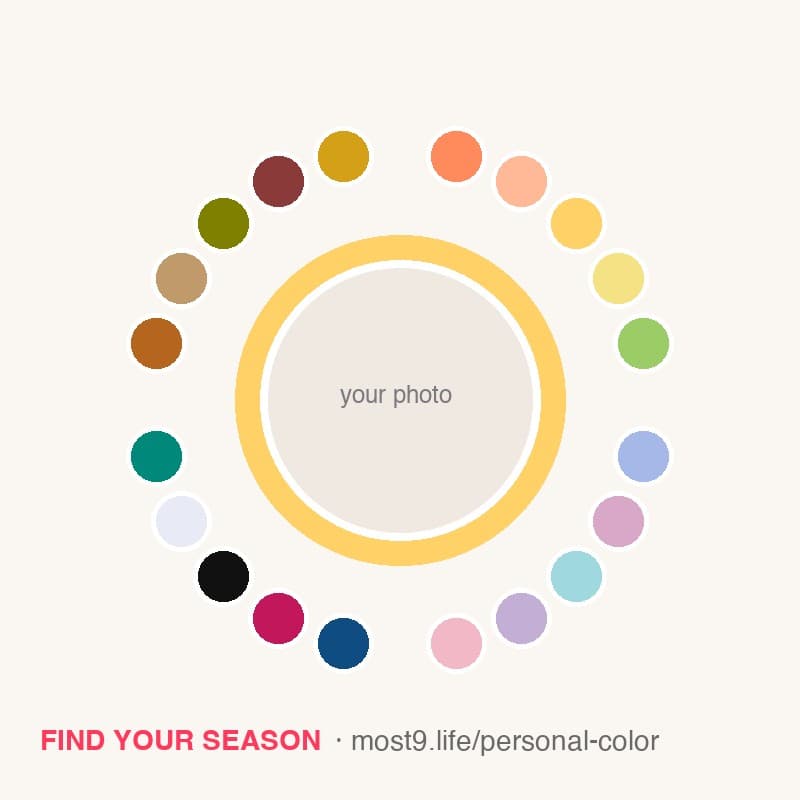
Personal color analysis isn't a Korean invention. The modern version traces back to American consultant Carole Jackson's 1980 bestseller Color Me Beautiful, which sorted people into four "seasons" — Spring, Summer, Autumn, Winter — based on skin undertone.
What Korea did was take that four-season framework and rebuild it with characteristic thoroughness. Most Korean studios now work with a refined 12-type system that evaluates not just warm-versus-cool undertone but also depth (light to deep) and clarity (muted to clear), splitting each season into subtypes like "light spring" or "muted summer." The result plugs directly into Korea's beauty retail ecosystem: walk out of a session and into a cosmetics store, and you'll find lip and blush shades labeled by personal color tone. It's a diagnostic that doubles as a shopping filter — which goes a long way toward explaining why the industry embraced it.
What actually happens in a session
A typical one-on-one session runs 60 to 90 minutes. You arrive with minimal makeup (studios advise skipping colored contacts too), your hair gets covered, and the consultant works through dozens of fabric drapes under color-corrected lighting — first establishing warm or cool, then narrowing down your subtype. You leave with a palette card of "your" colors, and usually specific recommendations: lipstick shades, eyeshadow families, jewelry metals, hair colors.
Pricing varies widely. One detailed review puts standard sessions at roughly ₩70,000–200,000 (about $50–150), with premium studios charging more; Creatrip's studio roundup finds many one-on-one sessions starting around ₩100,000. Group sessions cost less per person. Popular English-friendly studios reportedly book out weeks in advance during peak travel season, so this is not a walk-in activity — reserve two to three weeks ahead at minimum.
The honest take: styling framework, not science
Here's where a reality check helps. Personal color analysis is a styling methodology, not a scientific measurement. There's no standardized certification across studios, and the assessment ultimately runs through a consultant's trained eye. Reviewers occasionally note results that clash with their own instincts — the review above describes disagreeing with the consultant's verdict on wearing black — and it's plausible that two studios could type the same person differently. In my view, that doesn't make it a scam; it makes it closer to a professional second opinion on your wardrobe than a lab test.
And as an experience, it delivers. You get 90 minutes of undivided attention from someone who thinks about color all day, a genuinely interesting demonstration of how much a drape of fabric changes your face, and a practical decision-making shortcut for the K-beauty shopping you were going to do anyway. That's a better value proposition than plenty of things tourists spend ₩100,000 on in Seoul.
If you're booking one
- Reserve early and confirm English support. Availability of English-speaking consultants varies by studio and time slot — check before you pay.
- Come bare-faced and bring your current makeup. Consultants can tell you whether your existing products fight your palette, which is half the practical value.
- Treat the result as a tool, not a rule. If you love a color outside your palette, wear it. The useful takeaway is understanding why certain shades wash you out — usually undertone mismatch — not obeying a laminated card.
- Time it before your shopping day. The palette card is most useful walking into Olive Young or Musinsa afterward, not after your suitcase is full.
Personal color analysis is the rare beauty trend that's more about self-knowledge than product. Korea didn't invent it, but it industrialized it, attached it to retail, and turned it into an export — which is about as K-beauty a story as it gets.
This article is independent editorial by Seoul Glow. Prices and availability are as reported at the time of writing — confirm details directly with studios before booking.