Spend one evening socializing in Seoul and you will be asked a question that functions somewhere between small talk and a background check: "MBTI가 뭐예요?" — what's your MBTI? Come without an answer and someone may pull out their phone and make you take the test on the spot.
Korea's relationship with personality typing goes far beyond a passing internet quiz. It's a genuine cultural system — one that shapes dating, hiring debates, marketing, and an endless stream of viral tests. Here's how it works, where it came from, and how to play along.
Four letters as social infrastructure
MBTI — the Myers-Briggs Type Indicator, which sorts people into 16 types like INFP or ESTJ — exists worldwide. But nowhere has it been absorbed into daily life quite like Korea, especially among people in their 20s and 30s. Types appear on dating app profiles, product marketing, and TV shows, and celebrities announce theirs in interviews as routinely as their birthdays.
The dating layer is real: some people will happily tell you which types they date and which they avoid — certain pairings are memed as soulmates, others as disasters. And the trend has had sharper edges, too. When companies began referencing MBTI in recruiting — one major bank was criticized for asking applicants to submit their type — Korean media pushed back, with commentators warning that typing people this way slides into lazy discrimination. Psychologists have long noted the test's scientific limits as well; most Koreans quoting their four letters took a free online lookalike test rather than the official instrument, and plenty will cheerfully admit the whole thing is half a game.
That's the key to understanding it: MBTI in Korea is less a psychological instrument than a social one. It gives strangers an instant, low-stakes script — a way to be legible to each other quickly, in a culture where knowing where everyone stands matters.
Before MBTI: blood types
None of this started with Myers-Briggs. For decades, the same role was played by blood type personality theory — the folk belief (shared with Japan) that Type A people are careful, Type B are free spirits, Type O are confident, and AB are eccentric geniuses. "What's your blood type?" was the first-date question of an earlier generation, and the idea still floats around as retro trivia. MBTI essentially took over the slot with sixteen categories instead of four — a straight upgrade, if categorizing people is the game.
The sequel: are you teto or egen?
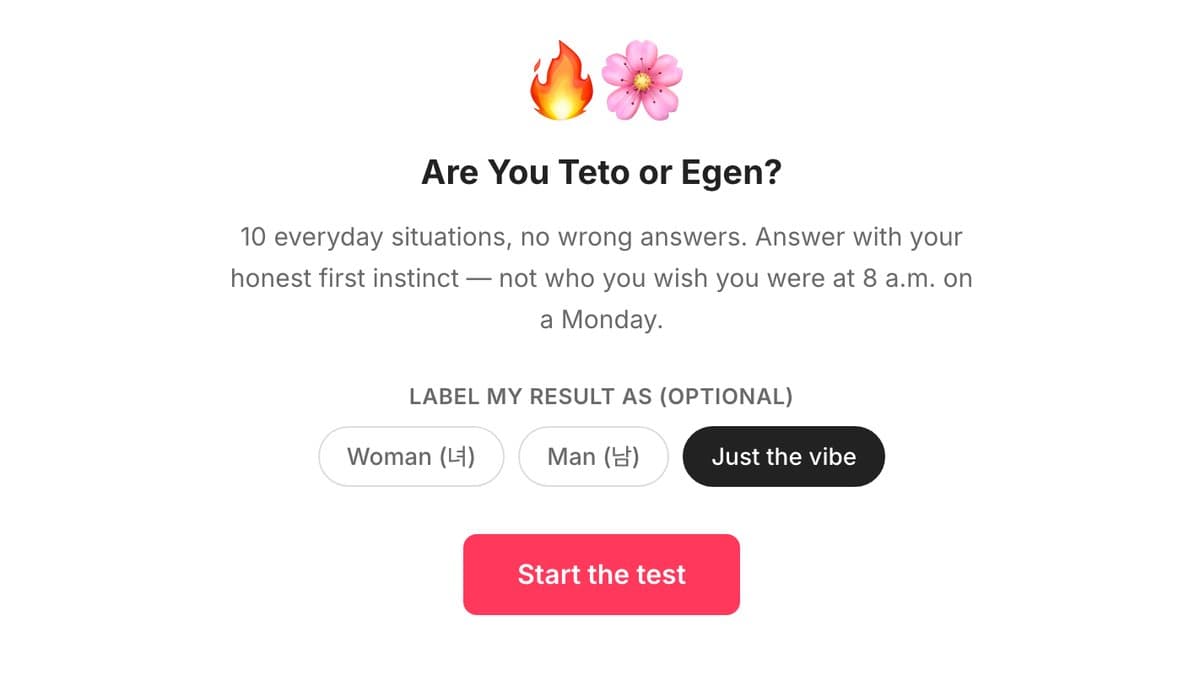
Korea doesn't let a typing system rest. The current wave is the teto-egen test (테토-에겐) — a playful typology named after testosterone and estrogen that sorts people by "energy" rather than gender: teto types read as bold, expressive and high-energy, egen types as soft, reserved and polished. By mid-2025 the most popular version of the test had drawn over a million participants, and an SNL Korea skit ("When a Teto Man Falls in Love") pushed it fully mainstream, with fans sorting K-pop idols into the four boxes on sight. We built a free English version of the teto-egen test — ten situations, your exact percentage split. It has no scientific basis whatsoever — even its Wikipedia entry leads with that — and that has stopped exactly nobody.
Notice the pattern: blood types, MBTI, teto-egen, plus personal color seasons, saju pillars, and zodiac animals. Korea keeps building new mirrors. Commentators tend to read this as a mix of things — a fast-moving, competitive society where quick self-definition is comforting; a group-oriented culture with a knack for categories; and, frankly, a world-class talent for turning anything into shareable content.
The viral quiz industrial complex
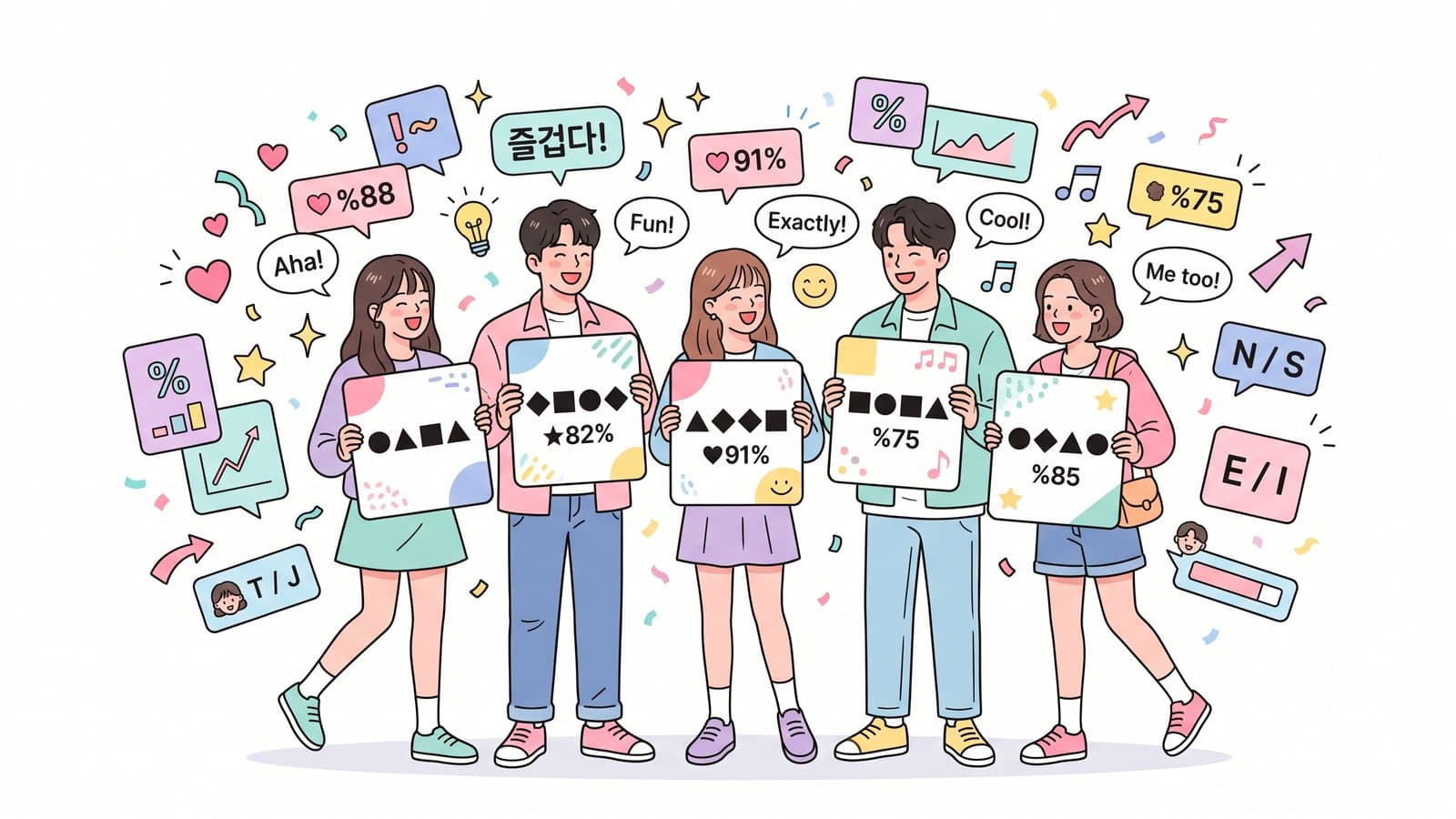
Beyond the big systems, Korea runs on a constant supply of one-off viral quizzes — "which bread are you," "your dating style as a dog breed," flower tests, ego tests — that sweep Instagram and KakaoTalk for a week at a time. The format is always the same: ten cute questions, a shareable result card, and a reason to compare answers with friends. If MBTI is the operating system, these are the apps.
Play along: the Korean self-discovery starter pack
If you want to experience the culture firsthand (and have your answer ready for Seoul small talk), work through the Korean stack:
- Your MBTI — any of the free 16-type tests online will do; just know your four letters and one fun fact about them.
- Your teto-egen type — the current wave, playable in English on our site in two minutes.
- Your personal color season — Korea's beauty-world answer to MBTI; our free browser tool estimates whether you're a Spring, Summer, Autumn or Winter.
- Your saju day pillar and zodiac animal — the traditional, birth-date side of Korean self-typing.
- Your dream readings — because in Korea, even last night's dream gets classified as lucky or unlucky.
MBTI, teto-egen, and their cousins are cultural entertainment, not validated psychology — Korean commentators say as much themselves. Enjoy them the way Koreans mostly do: as a game everyone has agreed to take just seriously enough to argue about.