Watch the credits of any K-drama and a pattern jumps out fast: Kim, Lee, Park, Kim, Choi, Kim. It's not a coincidence and it's not lazy casting. Kim alone covers 21.5% of South Korea's population, Lee 14.7%, and Park 8.4% — meaning those three names account for 44.6% of the country, per the national census. Ten surnames cover nearly two-thirds of all Koreans.
For comparison: the United States needs its top thousand surnames to cover that much of the population. So what happened in Korea? The answer is one of the best backdoors into Korean history — and it makes Korean names much more interesting than they look on a cast list.
How a Korean name is built
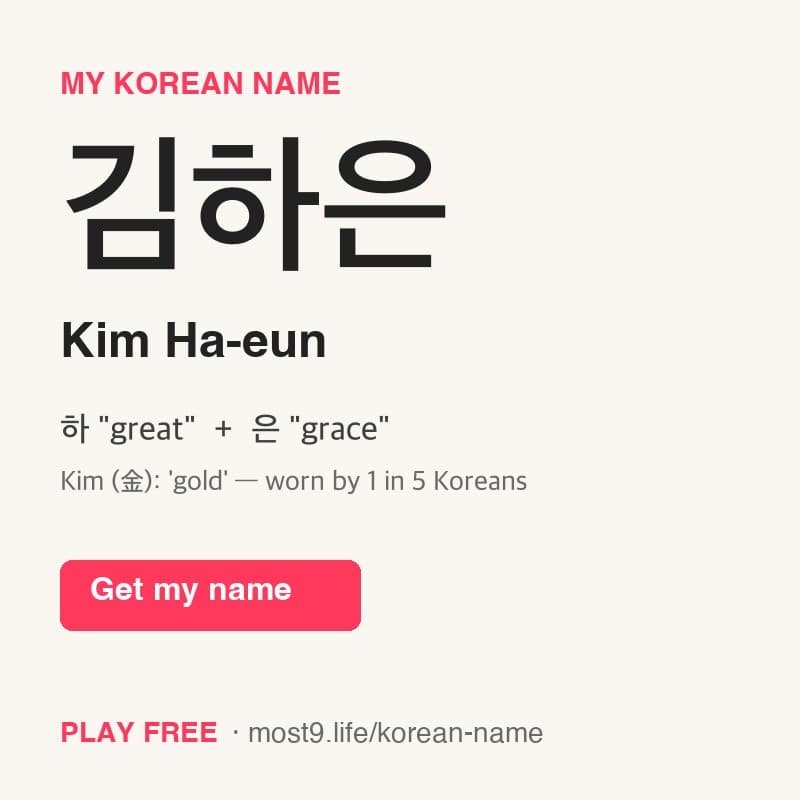
The structure first. A Korean name is almost always three syllables: family name first, then a two-syllable given name — 김하은 is Kim (family) + Ha-eun (given). The order never flips in Korean; "Kim Ha-eun" introducing herself as "Ha-eun Kim" is a concession to Western paperwork, not how the name works at home.
Two more things surprise newcomers:
- Women don't change their surname at marriage. A married couple usually has two different family names; the children take the father's (or, since a 2005 reform, optionally the mother's). What looks progressive is actually ancient — your surname marks your birth lineage, and lineage doesn't change.
- Koreans rarely call each other by name at all. Titles and relationship words (선배, 이모, 팀장님) do most of the work — a big enough topic that it deserves its own article (our banmal vs. jondaemal guide covers the politeness system behind it).
Why so few surnames? Blame status — and its buyers
Historically, surnames were an aristocratic privilege. For much of the Joseon dynasty, enslaved people and much of the commoner class had no surname at all; the prestigious names — Kim, Lee, Park among them — belonged to noble yangban lineages.
Then the system cracked. In the dynasty's chaotic final centuries, status became purchasable: struggling commoners bought, borrowed, or forged genealogies, overwhelmingly choosing the most prestigious names available. When surnames became legally universal in the early 20th century, the newly named followed the same logic — if you're picking a name, pick a royal one. The result: a country where the "rare" surnames are often older and more verifiably aristocratic than the common ones, and where nearly half the phone book shares three names.
The system that keeps this from being chaos is the bon-gwan (본관) — the clan seat. Every surname is paired with an ancestral hometown: a Kim isn't just a Kim but a Gimhae Kim or a Gyeongju Kim, with roughly 288 traditional surnames spread across more than 4,000 clans. Two Kims from different clans are, genealogically speaking, strangers.
The given name: a wish written in hanja
If surnames are inherited history, given names are engineered hope. Most Korean given names are built from two hanja (Chinese characters), each chosen for its meaning: 지혜로울 지(智) + 민첩할 민(敏) makes Ji-min, roughly "wise and quick." Parents agonize over these choices; many still consult professional naming offices (작명소) that weigh meanings, stroke counts, and the baby's birth hour.
Traditionally, one syllable wasn't even the parents' to choose: the dollimja (돌림자), a generational syllable shared by cousins of the same generation — so 민준's cousin might be 민서 and 민재, the shared 민 marking them as one generation of the clan. The custom is fading in younger families but still visible across older generations.
And a newer current runs the other way: pure Korean names that skip hanja entirely — 하늘 (sky), 아름 (beautiful), 이슬 (dew), 봄 (spring). Meanwhile the surname pool is quietly diversifying too: the 2015 census counted 5,582 surnames, most of them new names registered by naturalized citizens — the Kim-Lee-Park era isn't ending, but the edges of the system are moving.
The honest take: what a name tells you (and what it doesn't)
A Korean name is dense with information — generation, lineage, the exact flavor of their parents' hopes — but almost none of it is legible from the romanized spelling on a screen. "Lee Min-ho" could be 이민호 written with a dozen different hanja combinations, each a different name in Korean eyes. That's also why asking a Korean friend "what does your name mean?" is such a reliably good question: nearly everyone has a real answer, and often a story about who chose it and why.
One practical etiquette note for visitors: don't shorten Korean names. There is no "Min" for Min-jun the way there's "Mike" for Michael — the two syllables are a unit, and clipping one off can feel like being called half your name.
Get one of your own
The fastest way to feel how the system works is to have a name in it. Our Korean name generator assigns you a surname weighted by real population statistics (yes, you'll probably be a Kim — that's the point), plus a given name with each syllable's meaning explained. Consider it your entry in the great genealogy — no forged family register required.
This article is independent editorial by Seoul Glow. Census figures are from South Korea's 2015 Population and Housing Census as reported by The Korea Times and The Korea Herald.