If you've watched much recent Korean film and TV, you've met the mudang — the Korean shaman. The 2024 blockbuster Exhuma built a box-office phenomenon around shamans and cursed ground, and this summer Netflix's The East Palace has international critics writing phrases like "Korean shamanism's bureaucratic ghost logic" as the series climbs the non-English charts. For a lot of global viewers, these titles are their first contact with a spiritual tradition they didn't know existed.
Here's the context those dramas assume you have: what Korean shamanism actually is, how it connects to the very casual fortune-telling culture woven through everyday Korean life, and how to engage with it as a visitor without treating someone's living practice as a haunted-house attraction.
What "Korean shamanism" actually refers to
Korean shamanism — often called muism (무속, musok) — is Korea's indigenous spiritual tradition, older than the arrival of Buddhism or Confucianism on the peninsula. Its central figure is the mudang (무당), a ritual specialist — most often a woman — who mediates between people and spirits. Its best-known ceremony is the gut (굿): an intense, hours-long ritual of music, dance, costume, and spirit negotiation performed for healing, good fortune, or sending off the dead.
Two things surprise newcomers. First, it never died out: muism survived centuries of suppression and modernization, and practicing shamans — by common estimates, a very large number of them — work in Korea today. Second, it coexists rather than competes: Koreans who identify as Buddhist, Christian, or nonreligious may still consult fortune-tellers or observe folk customs. Muism functions less like a membership religion and more like a cultural substrate.
One thing to state plainly, because the dramas can mislead here: muism is not a national faith, and most Koreans today would not describe themselves as believers. Korea is a largely secular society where Christianity and Buddhism are the biggest organized religions, and plenty of Koreans regard shamanic ritual with indifference or open skepticism. What makes muism significant isn't how many people believe it — it's how long it has endured and how deeply it's woven into the culture's fabric. It is Korea's oldest continuous spiritual tradition, and the state itself treats it as heritage: major gut rituals are designated national intangible cultural properties, protected and transmitted the way court music or traditional dance are. Think of it the way many cultures hold their folk traditions — not universally believed, but collectively owned.
That's also why it keeps surfacing in K-content: for Korean storytellers, shamans aren't exotic — they're a familiar, ambivalent, dramatically rich part of the cultural furniture. The dramas are the export version of a tradition everyone recognizes, whether or not they believe in it.
The everyday layer: saju, sinjeom, and tarot
The gut ritual is the spectacular end of the spectrum. The everyday end is fortune consultation, which in Korea is about as charged as getting your palm read at a county fair — and far more common:
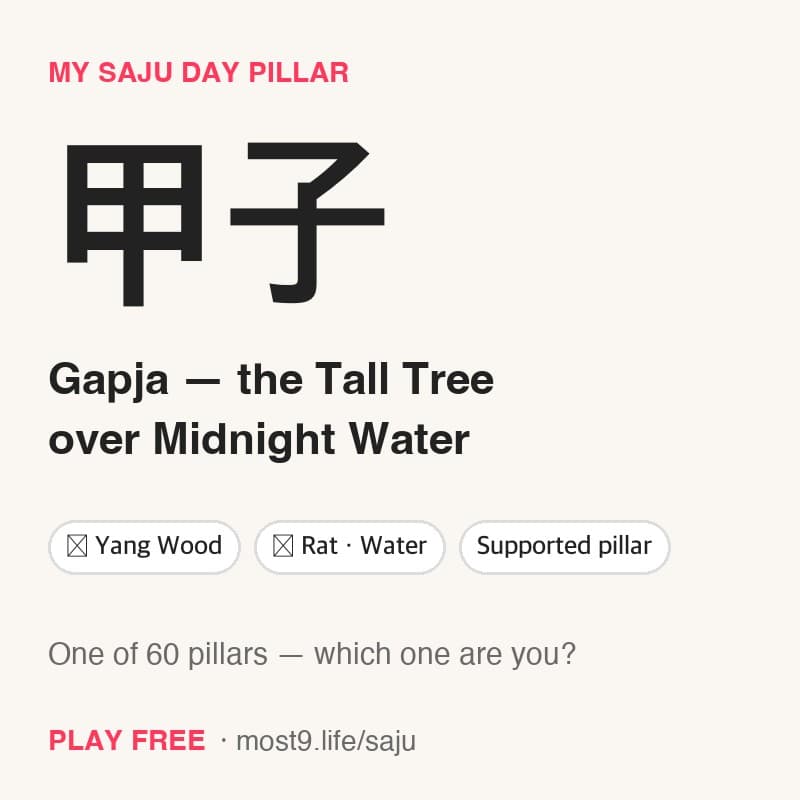
- Saju (사주) — "Four Pillars of Destiny": a reading based on the year, month, day, and hour of your birth, interpreted through a traditional East Asian framework. Koreans consult saju about career moves, relationships, big decisions — and famously about gunghap (궁합), marriage compatibility between couples.
- Sinjeom (신점) — a reading from a mudang, understood to come from spirits rather than a calculation system. This is the more serious, more personal tier.
- Tarot — the imported, low-stakes tier that boomed with younger Koreans. Tarot cafés cluster in youth districts, and a quick reading costs about as much as the coffee.
The cultural register matters: for many younger Koreans, a saju or tarot session sits somewhere between self-reflection, entertainment, and therapy-lite — the same social slot as Korea's famous MBTI obsession. It's a date activity. That casualness is exactly what confuses visitors who expect fortune-telling to be either deadly serious or pure kitsch; in Korea it's comfortably both and neither.
Where a visitor can experience it
- Saju and tarot cafés — The easiest entry point. They concentrate in student and nightlife districts — the streets around Hongdae are the classic hunting ground — and some cafés in tourist-heavy areas offer readings in English (check reviews before you sit down; language support varies a lot).
- Heritage performances — Several gut traditions are designated national intangible cultural heritage in Korea, and heritage foundations and cultural centers periodically stage them as public performances — the respectful way to see the music, dance, and costume up close.
- Museums and palaces — Folk museums in Seoul cover musok materials and ritual objects, useful for grounding what the dramas stylize.
- The screen version — Exhuma and The East Palace are genuinely decent cultural on-ramps, as long as you remember they're horror-thriller renderings, not documentaries.
How to engage respectfully
- It's a living practice, not a costume. Mudang are religious practitioners; a gut is a ritual with a client who's paying for something that matters to them. Public performances are for audiences — private rituals are not.
- Ask before photographing anything ritual-related, including shrine spaces you might stumble onto in the mountains around Seoul.
- Skepticism is fine; mockery isn't. Koreans themselves hold every possible attitude toward fortune-telling, from devout to dismissive — but the dismissive ones still generally treat practitioners with basic courtesy.
- Enjoy the low-stakes tier freely. Nobody will find it odd that a foreigner wants a tarot or saju reading — it's a normal, fun thing to do, and asking about your travel luck is a perfectly good opening question.
The bigger picture
Korea's fortune culture is having a very modern moment: saju apps and AI-reading services have turned a traditional practice into a smartphone habit, while global streaming turned the mudang into an international genre figure. That double life — ancient ritual on one screen, casual self-analysis on another — is very Korean: tradition doesn't get preserved behind glass here; it gets a UX update.
If the dramas hooked you, the real thing is more interesting, more ordinary, and more human than the ghost logic on screen. Start with a cup of coffee and four pillars.
This article is independent editorial by Seoul Glow. It describes cultural practices for context and travel purposes — we make no claims about the efficacy of any spiritual practice, and readings should be enjoyed as cultural experience. Descriptions of dramas reference their fictional portrayals.