Somewhere in your first month of Korean small talk, someone will ask a question that sounds oddly zoological: "무슨 띠예요?" — what's your animal? They're not making conversation about pets. They're asking your 띠 (tti), your Korean zodiac animal — and, quite possibly, they're politely working out your age.
The system in one minute
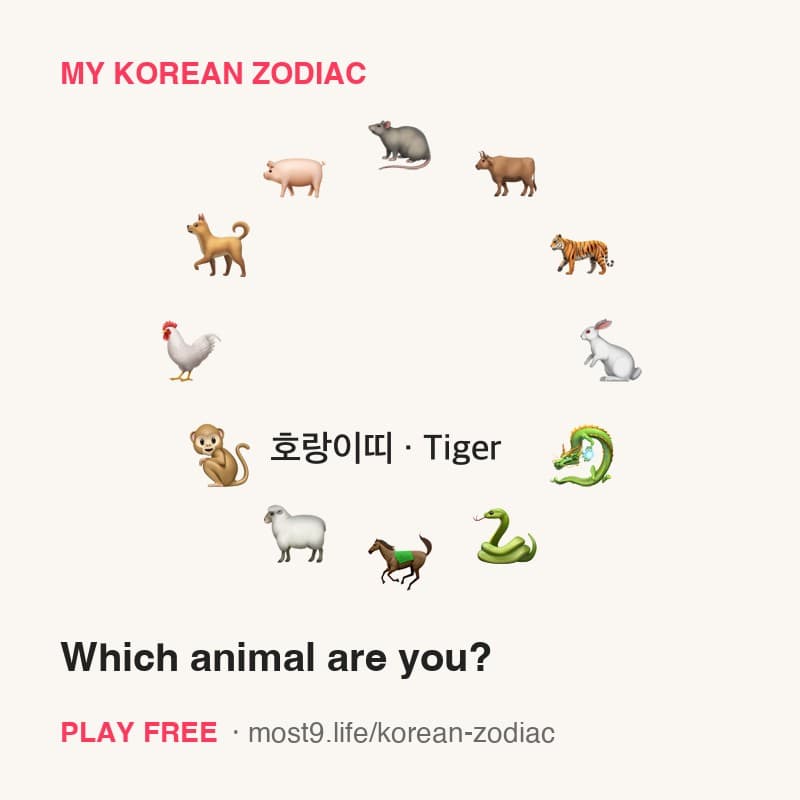
Korea shares the East Asian zodiac: twelve animals on a twelve-year loop — Rat, Ox, Tiger, Rabbit, Dragon, Snake, Horse, Sheep, Monkey, Rooster, Dog, Pig. Your birth year sets your animal for life: born in 1998, you're a Tiger (호랑이띠); 2002, a Horse (말띠); 2007, a Pig — and a famously lucky one, but we'll get there.
Two technicalities worth knowing. The zodiac year traditionally turns over at the lunar new year, not January 1 — so a late-January baby may belong to the previous animal, a detail Koreans themselves happily blur in casual use. And each year also carries one of five elements in the traditional sexagenary cycle, which is how you get special variants like a "golden" pig or a "blue" tiger year that headline every Korean January.
The real social function: age, politely
Here's the part guidebooks miss. Korean social life runs on relative age — speech levels, titles, who pours whose drink (our banmal vs. jondaemal guide covers why). But asking a grown adult's age point-blank can feel graceless. Asking their 띠 is the elegant workaround: learn someone's animal and you know their age to within a twelve-year band — and context does the rest. It's age-checking wearing a party hat.
The zodiac also gives Korean its own vocabulary of coincidence: a 띠동갑 is someone exactly twelve years apart from you — same animal, one full cycle away — a relationship Koreans find endlessly charming in couples and colleagues.
When a lucky year moves a whole country
If you want proof the zodiac still has real-world force, look at 2007 — the "golden pig" year, a variant folk belief holds to be exceptionally auspicious for wealth. That year, South Korean births jumped about 10 percent to roughly 497,000 — reversing years of decline — and schools later had to add classrooms for the golden-pig cohort, per the Korea JoongAng Daily. Dragon years get similar bumps across East Asia; the "once every 600 years" framing of the golden pig is folk numerology rather than settled math, but its effect on maternity wards was very real.
The zodiac's biggest annual stage is new year fortune season: every January (and lunar new year), portals, apps, and the classic Tojeong Bigyeol fortune books publish 띠별 운세 — fortunes by animal sign — and Koreans read them with the same wink-and-scroll energy Westerners bring to horoscopes. Cafés even sell zodiac-themed New Year goods, and the year's animal shows up on everything from stamps to soju ads.
The twelve, at a glance
The traditional shorthand for each animal's temperament — folklore, not psychology:
- Rat (쥐) quick and resourceful · Ox (소) steady and dependable · Tiger (호랑이) bold and charismatic
- Rabbit (토끼) gentle and tactful · Dragon (용) ambitious and magnetic · Snake (뱀) wise and private
- Horse (말) free-spirited · Sheep (양) warm and artistic · Monkey (원숭이) witty and inventive
- Rooster (닭) sharp-eyed and honest · Dog (개) loyal and fair · Pig (돼지) generous and lucky
Tradition also pairs the animals into well-matched trios (삼합) and warns about the sign directly opposite yours — the source of a thousand aunties' opinions on couples' compatibility. Nobody plans a wedding around it anymore; everybody still mentions it.
The honest take
Do Koreans believe in 띠? Mostly the way anyone believes in a good horoscope: selectively, socially, and with pleasure. It's less a prediction engine than a shared language — for age, for new-year hopes, for teasing a 띠동갑 couple. That's exactly what makes it worth knowing as a visitor: answer "무슨 띠예요?" correctly and you've passed a small, warm cultural handshake.
So learn your animal before you land. Our zodiac finder takes your birth year and gives you the animal, its traditional traits, your best-matched signs, and a just-for-fun reading you can save — consider it your first piece of Korean small-talk equipment.
This article is independent editorial by Seoul Glow. Zodiac traits and pairings are traditional folklore presented for cultural interest, not predictions; birth statistics are as reported by the Korea JoongAng Daily.