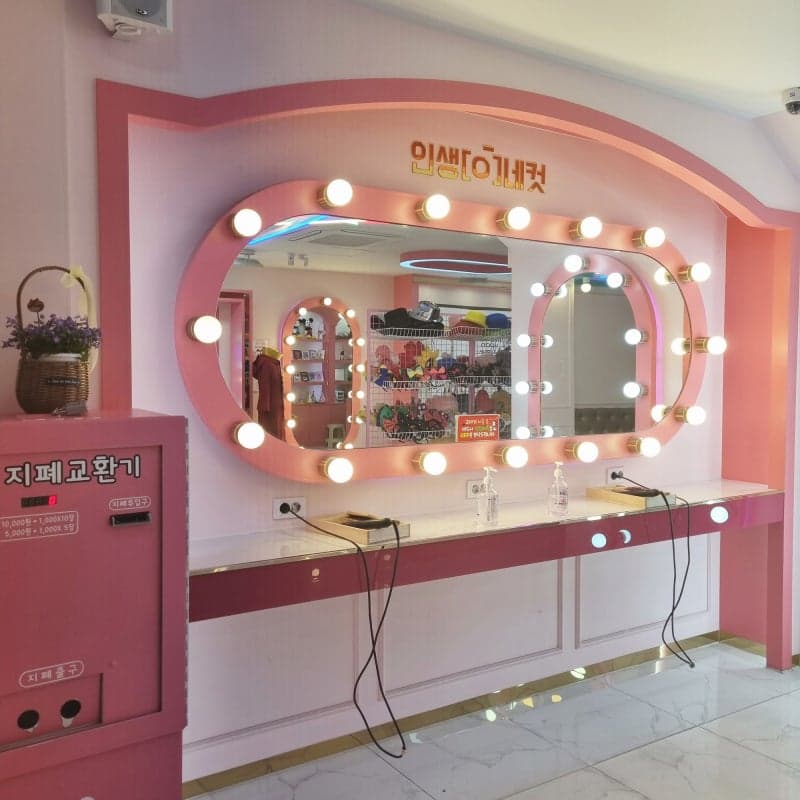
Somewhere between the cafés and the cosmetics shops, every lively street in Korea has a glowing, unstaffed storefront full of mirrors, prop baskets, and curtained booths. This is the four-cut photo studio — 인생네컷, "four cuts of my life," after the chain that started the boom — and it has quietly become one of the most beloved rituals in Korean social life.
If your image of a photo booth is the sad mall machine that prints passport photos, recalibrate: Korean booths are self-service mini studios with professional lighting, cinematic filters, free costume props, and a design culture around the printed strip. On social media, doing a four-cut run now sits on "things you must do in Seoul" lists alongside Gyeongbokgung and Han River chicken — and unlike most tourist rituals, this one is something Koreans genuinely do constantly.
Why Koreans love it
The four-cut strip solved a real problem: in the smartphone era, photos stopped being objects. A booth strip is small, dated, location-stamped, and physical — it goes in a wallet, on a mirror, into a diary. For Korean friend groups and couples, collecting strips became a way of journaling a relationship: same friends, different neighborhoods, years of strips.
It's also engineered for repeat visits. Booths are unstaffed and open late (many 24 hours), a session costs about the price of a coffee, and chains constantly rotate collab frames — idol groups, characters, seasonal designs — which turns frames into collectibles. When a popular K-pop collab frame drops, booths get actual queues.
The main brands, compared
Prices hover around ₩4,000–6,000 per session depending on brand and frame, with premium frames adding ₩1,000–3,000. The big names:
- Life4Cuts (인생네컷) — The original (founded 2017) and biggest chain; simple, bright, the default choice with the widest reach and heavy collab rotation.
- Photoism (포토이즘) — The main rival, known for flattering filters and polished frames; many idol collab events run here.
- Haru Film (하루필름) — The aesthetic pick: retro film-look color grading.
- Photogray, Selpix and others — A long tail of smaller chains, each with a signature tone.
You don't need to be picky on your first run — but Koreans absolutely are, and comparing brands' "skin tone" is a legitimate conversation topic.
Where to go
Anywhere young people gather, but the undisputed capital is Hongdae — the streets around Hongik University pack in dozens of booths within a short walk, often several brands side by side, which makes it perfect for a compare-and-collect crawl. Seongsu, Myeongdong, Gangnam, and every university district are similarly dense.
First-timer walkthrough
- Walk in. No staff, no booking. Grab props from the basket — headbands, glasses, character hats, all free.
- Pay at the screen (card or cash; most machines take foreign cards). Pick your frame — this is the big decision: layout, color, any collab design.
- Shoot. You get a countdown between shots — typically 6–8 takes for 4 slots, so you can afford two throwaway poses. Watch the monitor to adjust.
- Pick your best four and the machine prints your strips — usually two copies, so everyone leaves with one (buy extra prints for bigger groups).
- Scan the QR code before you leave: most brands give you the digital photos and a behind-the-scenes video of your session — the video is often funnier than the photos.
Pose culture tip: Koreans plan a loose sequence — one normal, one cute, one chaotic, one close-up. The props exist to kill self-consciousness; use them.
Why it's the perfect tourist ritual
A four-cut strip is arguably the best souvenir in Korea: it costs almost nothing, takes ten minutes, is literally impossible to buy anywhere else (it's you, in that neighborhood, on that date), and participating doesn't require a word of Korean. Do one in Hongdae with props, and one somewhere meaningful on your last night — the date stamp does the rest.
This article is independent editorial by Seoul Glow — no affiliation with any booth brand. Prices and machine features vary by location and change over time.