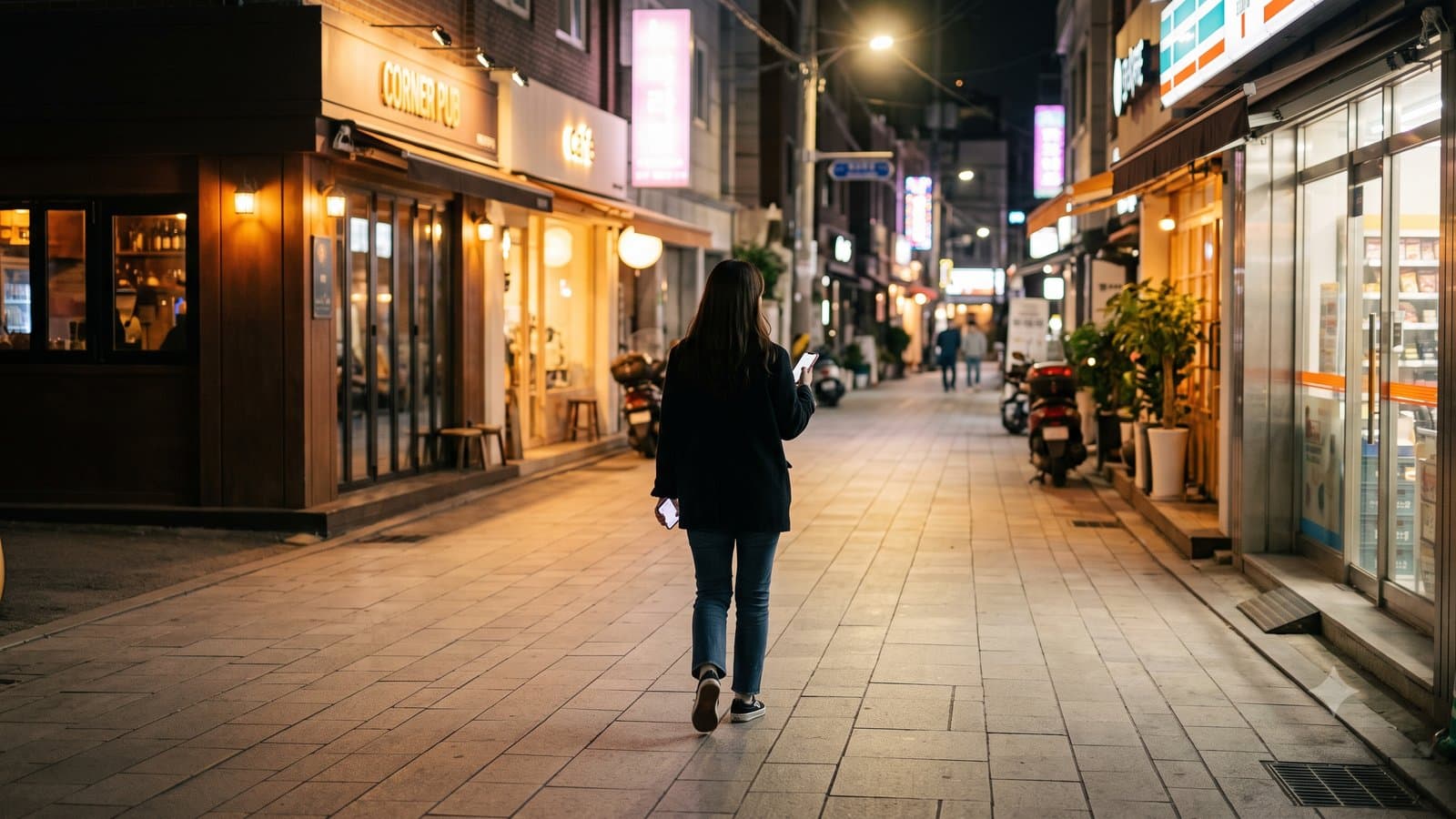
If your image of shopping in Seoul is a duty-free tower or a mega-mall, you're looking where the tourists look. Koreans who care about clothes shop by neighborhood — each district has a distinct personality, price bracket, and crowd, and locals move between them the way you'd flip through sections of a magazine.
Here are five of the neighborhoods Koreans themselves treat as street-fashion destinations, what each is actually good for, and how to shop it without wasting a day.
Seongsu-dong: the warehouse district everyone copies
Seongsu (성수동), in Seongdong-gu just east of the Han River, is the one to see first. A former light-industrial zone of print shops and shoe factories, it filled up over the last decade with cafés, concept stores, and brand flagships built into old warehouses and garages — which is why it's often described in Korean and international press as Seoul's answer to Brooklyn.
What makes it a fashion destination specifically is the pop-up culture. Brands — Korean and global, fashion and beyond — rotate temporary flagship experiences through Seongsu constantly, so the street literally changes month to month. That churn is the appeal: locals go to see what's new, not to hit a fixed list of shops.
- Good for: brand flagships, limited pop-ups, seeing the newest retail concepts
- Watch for: weekends are packed and popular pop-ups can mean real queues; go on a weekday if you can
Hongdae: youth style and vintage racks
Hongdae (홍대) — the area around Hongik University, Korea's top art school — is the youngest-skewing of the group. It's long been the center of Seoul's indie music and street culture, and the fashion follows suit: expressive, experimental, and cheaper than the Gangnam neighborhoods.
For street style, the draw is the density of vintage and secondhand shops tucked through the backstreets, alongside affordable trend-driven boutiques. It's where a lot of Korean students build a look on a student budget, so it's the best area for browsing without a big spend.
- Good for: vintage/thrift, affordable trend pieces, people-watching
- Watch for: it's as much nightlife as shopping — daytime is calmer for actually browsing
Garosu-gil: the tree-lined high street
Garosu-gil (가로수길) in Sinsa, Gangnam, is a ginkgo-lined avenue that became shorthand for polished, contemporary Korean fashion — boutiques, flagship stores, and cafés along one photogenic strip. As rents on the main road climbed, a lot of the more independent, interesting shops migrated into the surrounding backstreets, which locals nicknamed "Serosu-gil" (a play on garo, horizontal, vs. sero, vertical).
That's the insider move here: walk the main street for the big-name storefronts, then cut into the side lanes for the smaller labels.
- Good for: contemporary and minimalist Korean brands, a walkable upscale browse
- Watch for: the best independent finds are off the main road, not on it
Hannam-dong: quiet luxury and concept stores
Hannam (한남동), near Itaewon, is where Seoul's fashion goes grown-up and understated. It's a leafy, embassy-adjacent neighborhood known for high-end concept stores, designer boutiques, and gallery-like retail spaces — less about trends, more about curation.
If Hongdae is a student's closet and Seongsu is a rotating exhibition, Hannam is the neighborhood for considered, higher-end pieces and the kind of interior-design-forward stores that treat clothes like objects. It's also a natural pairing with the area's museums and cafés for a slower day.
- Good for: designer and contemporary labels, concept-store curation
- Watch for: prices match the postcode — this is browsing-as-inspiration if you're on a budget
Dongdaemun: fashion at 2 a.m.
Dongdaemun (동대문) is the opposite end of the spectrum — the manufacturing and wholesale engine behind a lot of Korean fast fashion. The district clusters around Dongdaemun Design Plaza (DDP), the swooping Zaha Hadid–designed landmark, and its retail malls famously run late into the night, with wholesale floors operating on an overnight cycle that supplies sellers across the country.
For a shopper, Dongdaemun is less about curation and more about volume, speed, and price — trend pieces at low cost, if you're willing to dig. It's a genuinely different rhythm from the boutique neighborhoods, and worth experiencing once just for the after-midnight energy.
- Good for: cheap trend pieces, sheer variety, late-night shopping
- Watch for: retail vs. wholesale floors have different rules and hours; it rewards patience over browsing
How to plan it
You can't do all five well in a day. A realistic pairing:
- Design-forward day: Seongsu in the afternoon → Hannam in the evening (both east/central, both about concepts and curation)
- Youth-and-value day: Hongdae browse → Dongdaemun after dark (both budget-friendly, both high-energy)
- Gangnam day: Garosu-gil and its Serosu-gil backstreets, easily half a day on their own
A few practical notes: most boutiques open late (11 a.m.–noon is normal) and stay open into the evening, so mornings are for cafés, not shopping. Card payment is universal, but small vintage and wholesale sellers may prefer cash. And Seoul's subway connects all five neighborhoods directly, which makes neighborhood-hopping genuinely easy.
This article is independent editorial by Seoul Glow — we have no affiliation with any store or district mentioned. Store line-ups and pop-ups change constantly, especially in Seongsu; treat this as a map of where to look, not a fixed shop list.