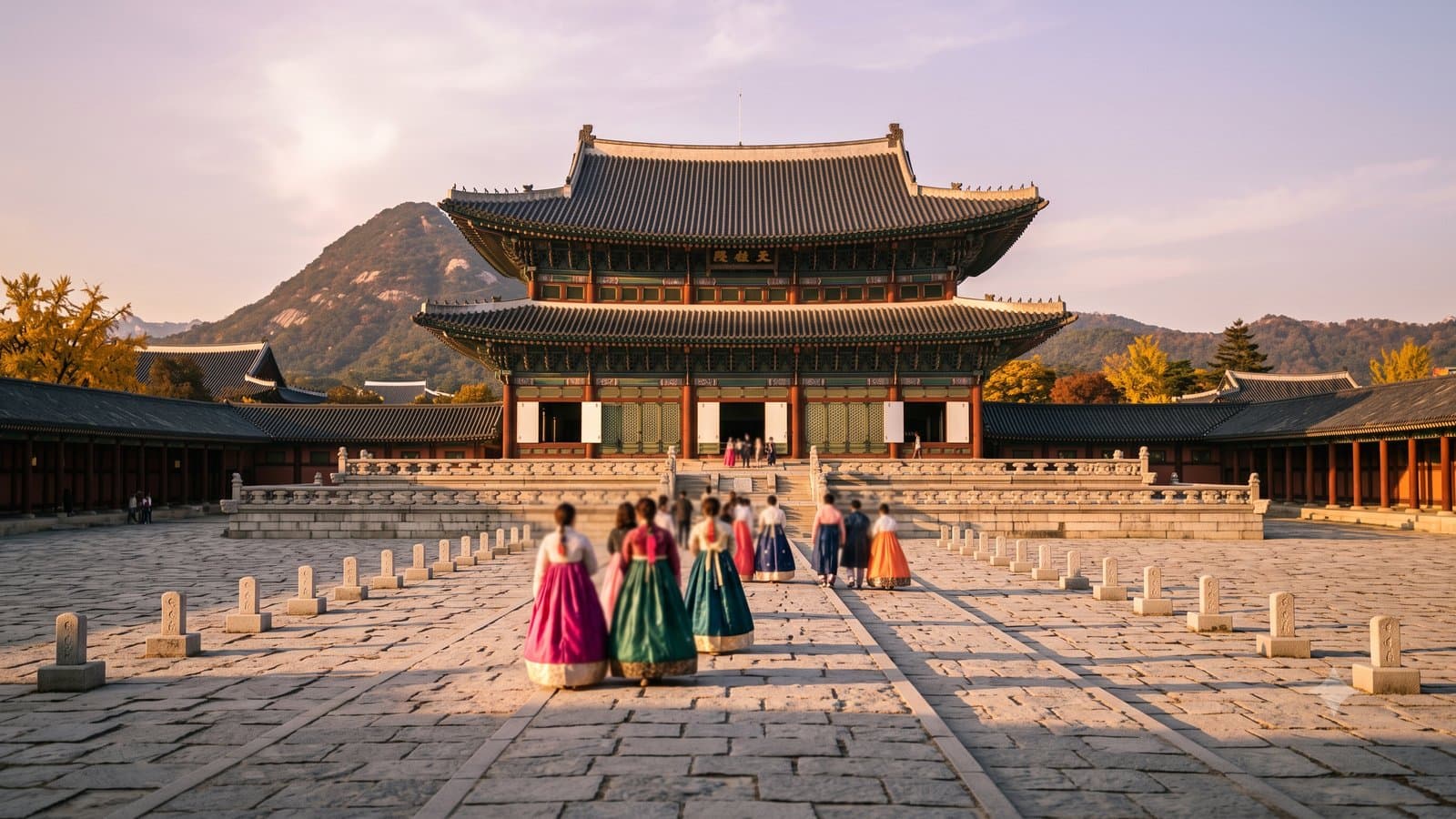
Every Korean historical drama you've ever watched — the court intrigue, the kings in red, the ministers bowing in ranked rows — is set on a stage that actually exists. It's called Gyeongbokgung (경복궁), it sits at the top of Gwanghwamun Square in central Seoul, and for about ₩3,000 (free if you're wearing a hanbok) you can walk into the frame.
Here's the palace with its story attached — because Gyeongbokgung is a far better visit when you know what you're looking at.
A palace that mirrors Korean history
Gyeongbokgung isn't just old; its biography is modern Korean history in miniature.
- 1395 — the founding statement. Three years after the Joseon dynasty was founded, its architects built Gyeongbokgung as the new capital's main palace — the seat of a dynasty that would last five centuries, per the palace's official history.
- The Sejong years — Korea's golden age happened here. King Sejong the Great ruled from this palace in the 1400s, and his royal research institute, the Jiphyeonjeon (Hall of Worthies), worked on its grounds — the project that produced Hangul, the Korean alphabet. If you've read our guide to learning Hangul or watched Tree With Deep Roots, this is where that story physically happened.
- 1592 — burned in the Imjin War. The Japanese invasions left the palace in ashes, and it sat in ruins for nearly 300 years while kings ruled from neighboring Changdeokgung.
- 1867 — the great rebuild. The regent Heungseon Daewongun reconstructed it at enormous cost as a statement of dynastic revival — roughly 500 buildings at its peak.
- The colonial era — dismantled again. Under Japanese rule most of the complex was demolished and a colonial Government-General building was planted in front of the throne hall. Its post-liberation removal in the 1990s, and the ongoing restoration that continues today (the rebuilt Gwanghwamun gate and its returned hanja signboard are recent chapters), made the palace a symbol of reclaimed identity.
That's why Koreans don't treat Gyeongbokgung as a photogenic ruin. It's a building the country has deliberately rebuilt, twice, to say something.
The sageuk connection: you know this place already
If you watch K-dramas, you've absorbed Gyeongbokgung's geography without realizing it. The throne hall where kings receive ministers in every sageuk? That's Geunjeongjeon, the palace's centerpiece, with its stone rank markers where officials stood in order. The pavilion on a pond where royal banquets (and drama love scenes) happen? Gyeonghoeru. The pretty hexagonal pavilion on an island that closes a hundred episodes? Hyangwonjeong.
One honest note: most sageuk are actually filmed at purpose-built sets and folk villages rather than inside the real palace — filming restrictions protect the site. But those sets are modeled on this layout, which means walking Gyeongbokgung feels less like seeing a location and more like walking the original of every palace you've watched. Fans of Kingdom, The Moon Embracing the Sun, or Under the Queen's Umbrella will recognize the grammar of the place instantly: the nested gates, the raised throne hall, the women's quarters tucked behind.
For the full historical-drama rabbit hole, our guide to the drama about Hangul's creation pairs perfectly with a visit.
The hanbok rule (and why everyone's dressed like royalty)
Gyeongbokgung's most photographed feature is its visitors: the palace grounds are full of people in rental hanbok, because wearing a full hanbok gets you in free — a policy designed to keep traditional dress alive, as visitor guides confirm. The streets between the palace and Bukchon are lined with rental shops; a few hours typically costs in the ₩10,000–20,000 range depending on the style, and shops usually handle hair accessories and storage for your bag.
Two tips from the culture side: rentals range from historically faithful cuts to glittery "fusion hanbok" — both are welcome at the palace, so pick by taste, not anxiety. And the free-entry rule expects a proper top-and-bottom hanbok, not just an accessory. (Your personal color season is genuinely useful here — hanbok come in every palette imaginable.)
Planning your visit
- Hours & closing day: roughly 9:00–18:00 with seasonal variation, closed Tuesdays, per Creatrip's current guide. Admission ₩3,000 for adults; free with hanbok.
- Royal Guard Changing Ceremony: in front of Gwanghwamun gate, usually 10:00 and 14:00, free to watch — Joseon-style uniforms, banners, and drums. Arrive a bit early for a front spot.
- Night opening (fall 2026): the palace's evening season runs September 2 – October 2, 2026, 19:00–21:30 — Gyeonghoeru lit against the dark is the single best photo the palace produces. Korean-resident tickets sell out online, but 300 same-day tickets are reserved for foreign visitors at the on-site booth (bring your passport).
- On the grounds: the National Palace Museum and National Folk Museum are both inside the complex and free — good rain plans. Our free museums guide has more.
- Getting there: Gyeongbokgung Station (line 3) exit 5 walks you straight in; see our Seoul transit guide.
Pair it with Bukchon Hanok Village next door and you have Seoul's best half-day of old Korea — dressed for the part, if you like.
Hours, prices, and event dates reflect official and cited sources as of September 2026 — check the official palace site before visiting, as ceremony schedules pause in bad weather and night openings are seasonal.