Here's a travel secret hiding in plain sight: of all the skills you could learn before a trip to Korea, the one with the best effort-to-payoff ratio isn't a phrasebook's worth of sentences. It's learning to read Hangul (한글), the Korean alphabet — a skill that genuinely takes most people a weekend, costs nothing, and changes how an entire country looks the moment you land.
That's not hype about a hard thing. It's the alphabet working exactly as designed — 580 years ago.
An alphabet invented to be easy
Most writing systems evolved over millennia. Hangul was deliberately engineered: King Sejong, the fourth king of the Joseon dynasty, introduced it in the 1440s so that ordinary Koreans — who had no realistic way to learn the thousands of Chinese characters used by the educated elite — could read and write. The promulgation document famously claims a wise man can learn the letters before the morning is over, and a fool within ten days.
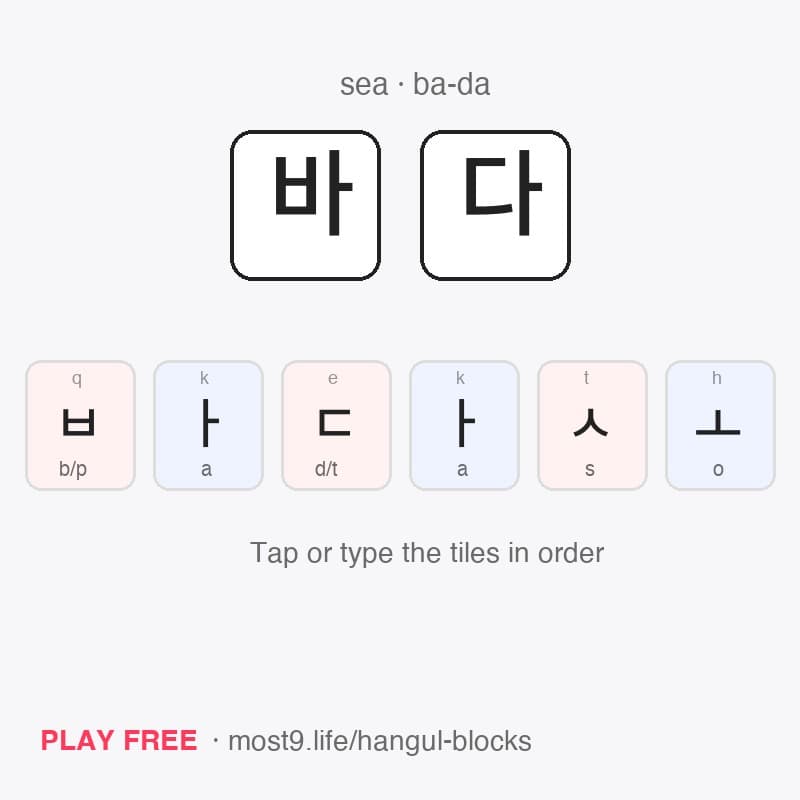
Marketing copy from the 15th century? Somewhat — but linguists have long admired the design. Hangul is a featural alphabet: the consonant shapes are stylized diagrams of your mouth making the sound (ㄴ traces the tongue touching the ridge behind the teeth; ㅁ is the closed lips), and related sounds share related shapes. There are only 24 basic letters, which stack into syllable blocks — so 한글 is six letters arranged as two blocks, han (한) + geul (글).
Compare the honest workload: Japanese requires two syllabaries plus ~2,000 kanji for literacy; Chinese, thousands of characters. Hangul asks you to memorize roughly as many symbols as the Latin alphabet, with more internal logic. Korea celebrates the invention with a national holiday — Hangeul Day, October 9 — which tells you how central the alphabet is to the culture's self-image.
The honest take: reading is not speaking
Let's keep the promise precise, because this is where language-learning content usually oversells:
- Learning to read Hangul is genuinely fast. A focused weekend — or a few commutes with an app — gets most people sounding out words.
- Learning Korean is genuinely slow. Grammar, honorifics, and vocabulary are a multi-year project; the US Foreign Service Institute classifies Korean among the hardest languages for English speakers. Reading the menu is not understanding the waiter.
- Reading alone is still worth it. A surprising share of what you'll decode is recognizable: 커피 (keo-pi = coffee), 아이스크림 (ice cream), 버스 (bus), 치킨 (chicken). Konglish loanwords mean that in a Korean city, being able to sound out signs converts to real comprehension constantly — plus subway station names, cosmetics labels, and menu items stop being wallpaper.
- Skip romanization as fast as you can. Reading Korean words in Latin letters teaches wrong pronunciation habits (the same letter "eo" hides two different vowels). Hangul tells you exactly what sound to make; that's its whole job.
Where to learn it free
No paid app required — Korea's government would genuinely like to teach you:
- Online King Sejong Institute — the Korean government's free online language platform, with self-paced courses from absolute beginner (including a dedicated Hangul course) to advanced. This is the official, no-catch option: register and start.
- National Hangeul Museum in Seoul — an entire museum dedicated to the alphabet, next to the National Museum of Korea (Ichon Station), with free admission. Worth an hour on any Seoul itinerary even if you never study a letter: the story of the alphabet's invention and suppression is one of Korea's best historical narratives.
- Free apps and web courses — Duolingo's Korean course covers Hangul at no cost, and free web guides abound. For pure reading practice, any method that drills letter-sound pairs works; the alphabet is forgiving of study style.
- In Seoul, look for hands-on moments — calligraphy programs at cultural centers and the museum's exhibitions turn practice into a tourist activity. Writing your name in Hangul is the standard first thrill.
- Our free Hangul typing game — once you know the letters, put them in your fingers: Korean words fall from the sky and you type them before they land. Your regular keyboard becomes a Korean one, with each key highlighted. No install, no Korean IME needed.
A realistic weekend plan
- Day 1, morning: the 14 basic consonants — as mouth-shape diagrams, not arbitrary symbols. Afternoon: the 10 basic vowels, built from just three elements (a horizontal line, a vertical line, a dot).
- Day 2: how letters stack into syllable blocks, plus the doubled/aspirated consonants. Then read real things: K-pop group names, a Korean restaurant menu, cosmetic brand names you already know.
- The following week: every Korean word you encounter is now practice. Decoding 서울 (Seoul) off a real sign for the first time is a small, genuine rush.
The deeper reason to bother is cultural: Koreans are visibly delighted when visitors can read even a little, precisely because Hangul is the national invention they're proudest of. You're not just learning a script — you're paying a compliment the whole country notices.
This article is independent editorial by Seoul Glow. Resources listed are free as of August 2026; course offerings and museum hours can change — check official sites before visiting.