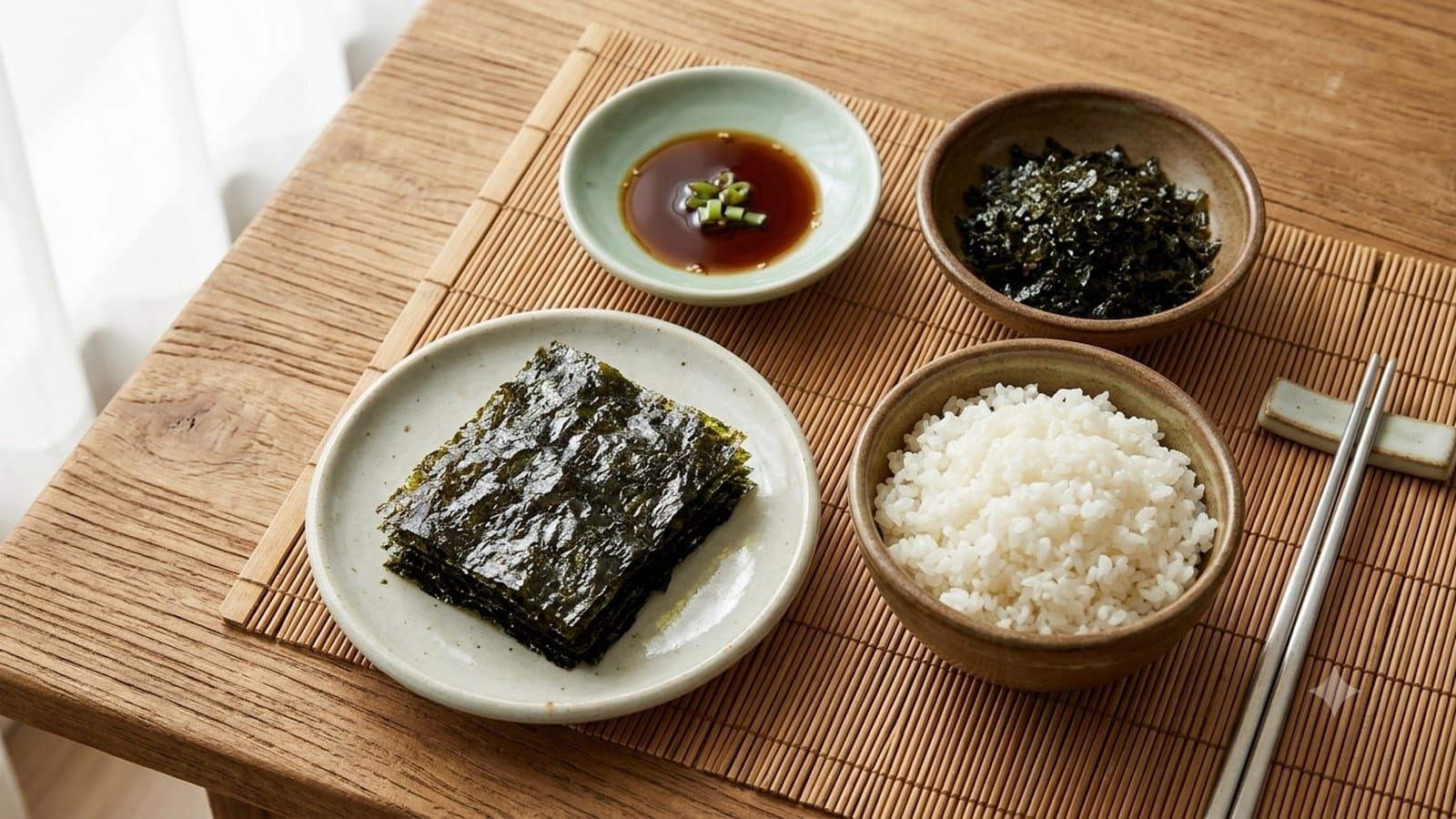
If tteokbokki is Korea's comfort food, kimbap (김밥) is its logistics miracle: rice, vegetables, egg, and something savory rolled in roasted seaweed, sliced into coins, and engineered to be eaten anywhere — picnics, trains, exam halls, office desks. It's the food Korean parents pack at dawn for school field trips, and the one item on every bunsik menu that nobody skips.
It also has two things most visitors don't expect: a genuinely contested origin story, and a price spectrum that has quietly become a news topic in Korea. Here's both.
The history: older than you think, and argued about
The seaweed itself has deep roots. Gim (김) — the roasted laver that wraps the roll — appears in Korean records from the Joseon era, with 15th-century regional documents describing laver as a local product of the southern coast, and traditional accounts of eating rice wrapped in gim (a practice tied to bokssam, the lunar-new-year custom of wrapping rice for luck).
The modern roll is where the argument starts. One school holds that today's kimbap took its form under Japanese colonial rule (1910–1945), influenced by Japanese norimaki — same basic architecture, adapted to Korean fillings and sesame-oil-seasoned rice instead of vinegared rice. Another school argues the wrap-rice-in-gim habit is indigenous and the modern roll is a continuation of it, not an import. Korean food historians land in different places, and the honest answer is that both influences are probably in the roll: a Korean ingredient tradition, a format accelerated by the colonial period, and a thoroughly Korean result — by the postwar decades, kimbap had become the default portable meal of Korean daily life, sold in every bunsik shop alongside tteokbokki.
Two regional styles are worth knowing because they're destinations in themselves:
- Chungmu kimbap (충무김밥) — from Tongyeong on the south coast (formerly Chungmu). Plain, filling-free rice rolls served with spicy squid and radish kimchi on the side. The style is usually explained as a fisherman's meal designed not to spoil at sea — a story that's part history, part local legend, but the dish is real and Tongyeong's harbor-front is lined with restaurants serving it.
- Mayak kimbap (마약김밥) — the bite-size "addictive" rolls of Seoul's Gwangjang Market, minimalist rolls with a mustard dipping sauce whose nickname ("narcotic kimbap") refers to how fast a plate disappears.
What kimbap costs in 2026
Kimbap's identity in Korea has always been "the cheapest complete meal" — which is exactly why its price gets national media attention when it rises. Per Korea Consumer Agency price tracking reported in Korean media, a basic roll in Seoul averaged about 3,800 won (~$2.80) in March 2026, up 7.4% from a year earlier, driven by rice and egg costs. Specialty rolls — tuna, cheese, bulgogi — commonly run 5,000–6,000 won at neighborhood shops.
The practical price map runs by venue type more than by city:
| Where | Typical price (1 roll) | What you get |
|---|---|---|
| Convenience store (GS25, CU…) | from ~1,500 won | Packaged triangle gimbap/rolls; the true budget floor |
| Bunsik chains (Kimbap Cheonguk etc.) | ~3,000–4,000 won | The classic experience; made to order |
| Neighborhood/market shops | ~3,500–6,000 won | Basic rolls at the low end, tuna/cheese at the high |
| Artisan/premium kimbap shops | ~5,000–9,000 won | Trend-driven fillings, premium rice and gim |
Regional variation is real but narrower than it used to be described: Seoul sits at the top of the range, and smaller cities generally undercut it (a decade ago consumer-price data put Busan several hundred won below Seoul per roll, and the capital has stayed the expensive end since). If you're budgeting a trip: outside Seoul, expect the same menu for a few hundred won less per roll — and everywhere, the convenience-store tier is the constant.
Worth knowing as context: Korean media in 2026 have covered the squeeze on kimbap shops from both directions — ingredient costs rising while the dish's "cheap meal" identity caps what shops feel they can charge. That tension is why the humble roll makes headlines.
How to order like a local
- Basic first. A plain yachae (vegetable) kimbap is the benchmark — if a shop nails it, everything else follows.
- The classic pairing is kimbap + tteokbokki, dipping the former in the latter's sauce, or kimbap + a hot bowl of ramyeon.
- Watch the verbs: pojang (포장) is takeout — kimbap's natural state. Most shops will roll it fresh in front of you in under two minutes.
- Convenience-store kimbap is not a downgrade — it's its own genre Koreans genuinely rely on, and trying a triangle gimbap from a GS25 at midnight is a legitimate cultural experience.
The bigger picture
Kimbap tells the same story as bunsik culture at large: a food born from frugality that became an identity. Its origin is tangled with a difficult century, its price is a running national conversation, and its best versions are found in markets and harbor towns rather than fine-dining rooms. For a traveler, it may be the single best food-per-won purchase in the country.
This article is independent editorial by Seoul Glow. Prices are averages reported as of early-to-mid 2026 and will drift — treat them as orientation, not a menu.