Every Korean dinner table has a quiet workhorse: gim (김) — paper-thin sheets of roasted seaweed, salty and shatter-crisp, stacked next to the rice like edible napkins. For most of history it was the humblest thing on the table. Then the world discovered it, and Korea now exports so much that the country's media nicknamed it the "black semiconductor" — a joke comparing seaweed to Korea's mightiest export that stopped being a joke: in 2025, gim exports passed $1 billion for the first time, led by American demand.
Here's the full story of Korea's most underrated food — and how to eat and buy it like you know it.
The past: the world's first seaweed farmers
Koreans were gathering and eating gim by the 13th century, but the pivotal moment came in the 1640s, when Kim Yeo-ik, a fisherman in Gwangyang on the southern coast, developed a method of cultivating seaweed on bamboo and tree-branch frames set in tidal waters — considered the earliest known seaweed farming in the world. Gwangyang still honors him with a memorial; the southern coasts of Jeolla province remain gim country to this day.
For centuries afterward, gim was the definition of everyday food: dried by the sea, brushed with oil, flashed over fire, and laid on rice. Its role never really changed — the world around it did.
The present: the billion-dollar sheet
The numbers behind the "black semiconductor" nickname are real. Korea supplies over 70 percent of the global gim market; exports hit a record $997 million in 2024 and crossed the billion-dollar line in 2025. The engine is snacking: the crispy seasoned snack-gim format conquered American grocery aisles, and the frozen-gimbap craze pulled the whole category with it. Global demand has risen so fast that Korean media now covers gim price inflation at home — the once-humblest banchan, becoming precious.
If you grew up thinking of seaweed as sushi wrapping, Korean gim is a different animal: roasted with oil (traditionally perilla or sesame) and salt, engineered for crispness, and eaten as food in its own right, not packaging.
How to eat it so it's actually delicious
The Korean playbook, from basic to enlightened:
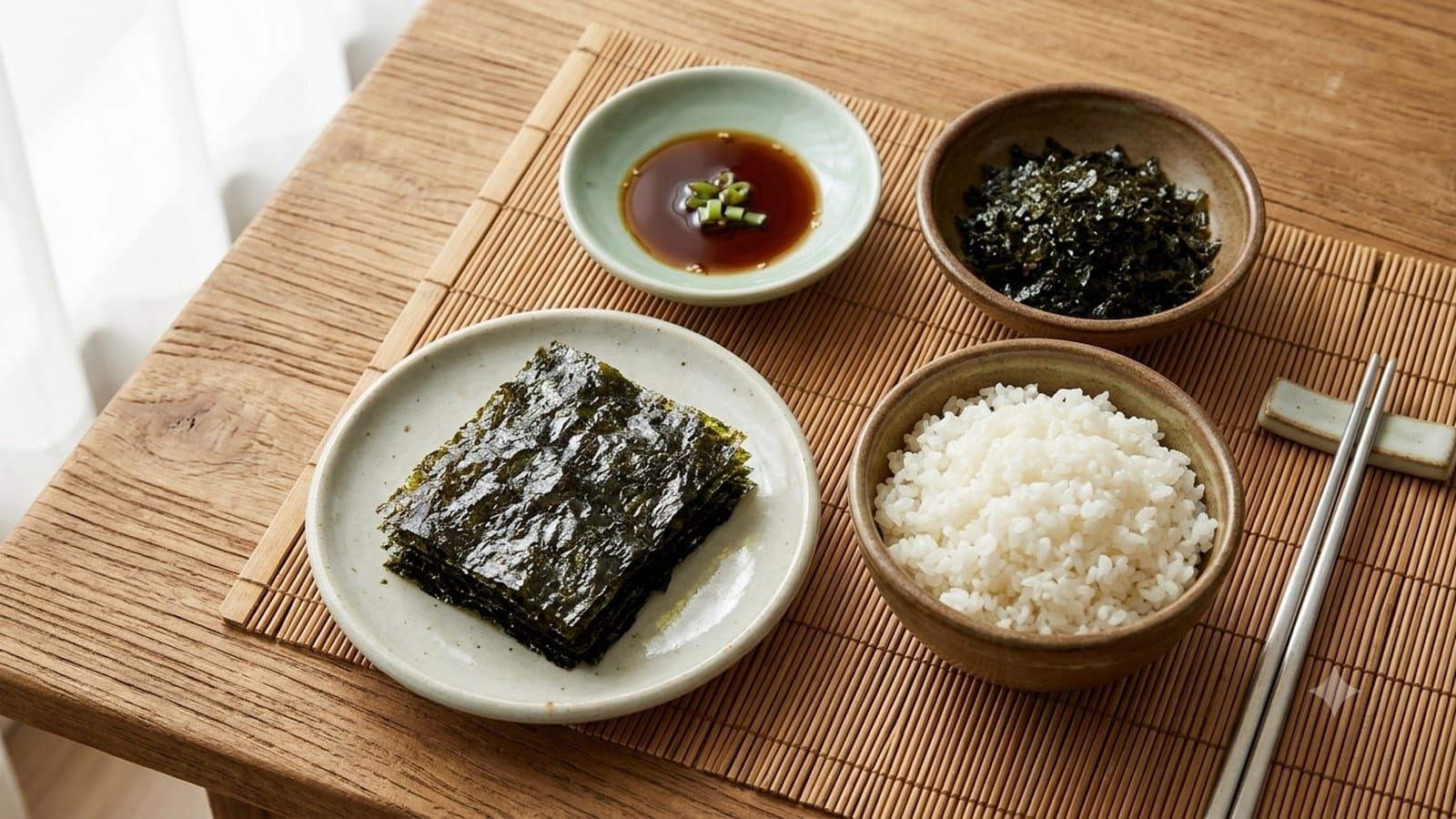
- The fundamental move: gim + hot rice. Lay a sheet on your palm, add a bite of warm rice, fold, eat. The heat wakes up the oil and toastiness. A tiny dab of soy sauce on the rice is classic; with good gim you won't need it.
- Respect the crispness. Gim's enemy is humidity — open packets get eaten, not saved. The little desiccant packet is doing holy work; reseal or finish.
- Know your two main types. Jomi-gim (조미김) — oiled, salted, pre-cut, snackable, what's in every lunchbox packet. Gim-gui (whole roasted sheets, often perilla-oil) — bigger, less salty, for wrapping rice; the connoisseur pick is perilla-oil (들기름) gim from the southern coast.
- Gim-jaban (김자반) — crumbled seasoned gim flakes, slightly sweet; the ultimate rice topper and the reason a bowl of plain rice disappears. Convenience stores sell it; kids live on it.
- Gim-bugak (김부각) — the fancy one: gim brushed with glutinous rice paste, dried, and fried into a puffed, glassy chip. Temple food origins, now a Seoul gift-shop darling and one of Korea's best snacks, full stop.
- And of course, gimbap — the seaweed roll that carried gim to global fame, one convenience store at a time.
Butter-on-warm-gim is a modern home hack worth trying once; Koreans will debate you about it, which is half the fun. For the wider banchan context, our Korean side dishes guide covers where gim sits on the table.
Where to buy it as a traveler
Gim is arguably the best food souvenir from Korea: flat, light, cheap, allowed in checked luggage virtually everywhere, and beloved by whoever you give it to.
- Big marts (E-mart, Lotte Mart, Homeplus) — the widest selection and gift sets with handles, from budget multi-packs to premium perilla-oil sheets from named producing regions (Gwangcheon and Wando are the famous origin names to look for). Best price-per-quality.
- Traditional markets — Gwangjang and Namdaemun sell gim in generous stacks; vendors will vacuum-pack for travel and let you taste. The gift-set ribbon is optional; the flavor is better than the packaging suggests.
- Convenience stores — for immediate snacking: single jomi-gim packets and gim-jaban tubs, ₩1,000–2,000. Try before you commit to a suitcase-load (our CVS food guide has more).
- Department store food halls — the premium gim-bugak and artisanal perilla-oil brands, beautifully boxed for gifting, at prices that reflect the box.
- Airport duty-free works in a pinch but marks up heavily — buy in the city, pack flat.
One practical note: seasoned gim is oiled, so check your destination's food-import rules if strict (Australia and New Zealand travelers know the drill) — dried, packaged, and commercially sealed is generally the safe category.
Export figures and history are from the cited reporting as of September 2026. This is independent editorial — no brand affiliations; we just eat an alarming amount of gim.