Tell a Korean friend you dreamed about a pig last night and watch what happens: someone will tell you — possibly urgently — to buy a lottery ticket before the luck wears off. Mention that your teeth fell out in a dream and the room gets quieter. Korea has one of the world's liveliest surviving traditions of dream interpretation, called kkum-haemong (꿈해몽), and it runs on a logic that's often the exact opposite of what Western dream books say.
Here's how the system works — and how to look up your own dream. (Try our free Korean dream dictionary alongside this guide.)
Good dreams, bad dreams, and dog dreams
Korean tradition sorts dreams into gilmong (길몽) — auspicious dreams — and hyungmong (흉몽), the unlucky kind. There's also a third, very Korean category: the gae-kkum (개꿈), literally "dog dream," meaning a chaotic dream of no significance at all. Being told "that's just a dog dream" is the standard way to be reassured after a weird night.
What makes the Korean system fun for outsiders is its reversals. As Gwangju News' overview of Korean dream culture lays out, several dreams that sound terrible are read as excellent news:
- Dying in a dream is a rebirth sign — the old chapter ends, a better one starts.
- Dreaming of poop — stepping in it, especially — is one of the strongest money omens in the entire tradition.
- A house on fire means business and fortune blazing upward.
- Sobbing uncontrollably reads as release: troubles washing out, good news coming in.
And the reversals cut the other way too: picking up money in a dream is traditionally read as money about to leave your real wallet, and in older readings even attending a wedding could be a warning rather than a celebration.
The most feared dream is the one that needs no cultural translation: teeth falling out, read as losing someone or something dear — folk detail says upper teeth point to your elders, lower teeth to those younger than you (Korean Culture Blog has a classic rundown).
The pig dream and the lottery counter
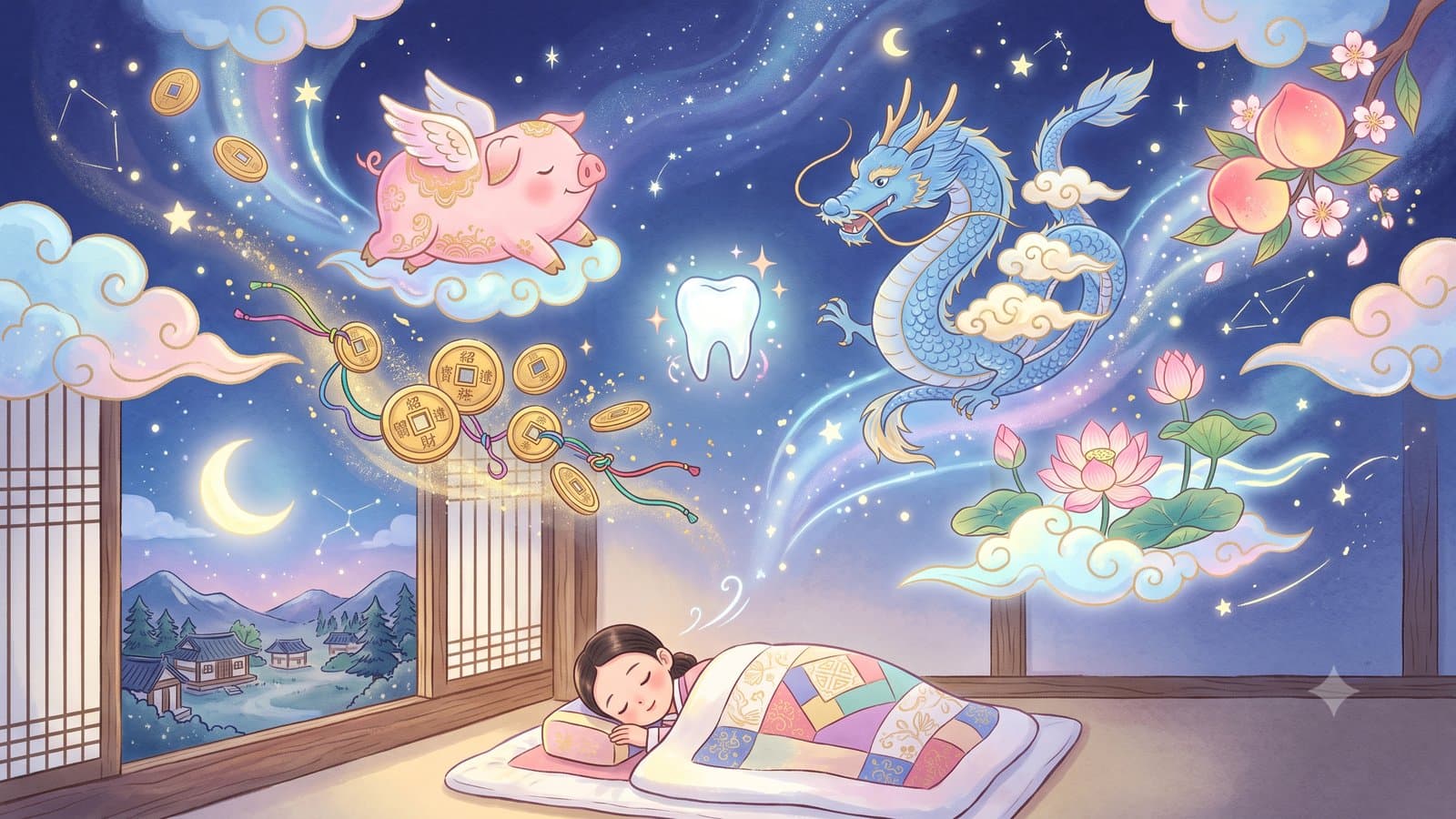
The undisputed king of Korean lucky dreams is the pig (돼지) — a symbol of wealth so established that pig dreams and lottery tickets are a fixed pair in Korean life. Dream of a pig entering your house, or better yet catch and hold one, and convention says a windfall is near; Creatrip's guide to common Korean dream readings puts pigs at the top of the money-dream list alongside dragons and, yes, poop.
Nobody claims this is science — Koreans will laugh about it while standing in line at the lottery counter anyway. It belongs to the same cheerful, half-believed layer of everyday fortune culture as saju readings and zodiac animals: entertainment with deep roots.
One rule is taken semi-seriously, though: a good dream should not be told before it comes true. Speaking it out loud is said to spill the luck. If a Korean friend refuses to tell you their dream this morning, congratulations — it was probably a good one.
Taemong: the dream that announces a baby
The most distinctive branch of Korean dream culture is the taemong (태몽) — a conception dream believed to foretell a pregnancy and hint at the child's future, experienced by the mother or sometimes a father, grandmother, or close friend, as documented in the USC folklore archive's entry on taemong. Ask a Korean what their taemong was and there's a good chance they know: families retell them for decades.
The classic taemong symbols are vivid: dragons for a child destined for greatness, tigers for courage, large snakes, ripe fruit (chestnuts and peaches are the all-stars), flowers, and — at the royal end of the scale — swallowing the sun or moon, the kind of dream historically claimed for kings and prodigies.
The pee dream that made a queen
Korean dream culture even allows dreams to be bought and sold — and the founding story is a good one. In the Samguk Yusa, Korea's 13th-century collection of histories and legends, a Silla noblewoman named Bohui dreamed of urinating so much it flooded the capital. Her younger sister Munhui recognized it as a dream of immense fortune and bought it, paying with a silk skirt. Munhui went on to marry Kim Chun-chu — the future King Muyeol — and become Queen Munmyeong, mother of the king who unified the Three Kingdoms.
Dream-selling survives as folklore logic to this day: luck is transferable, but only if the buyer pays for it. And yes — this is why an epic pee dream still counts as a first-class omen.
Look up your own dream
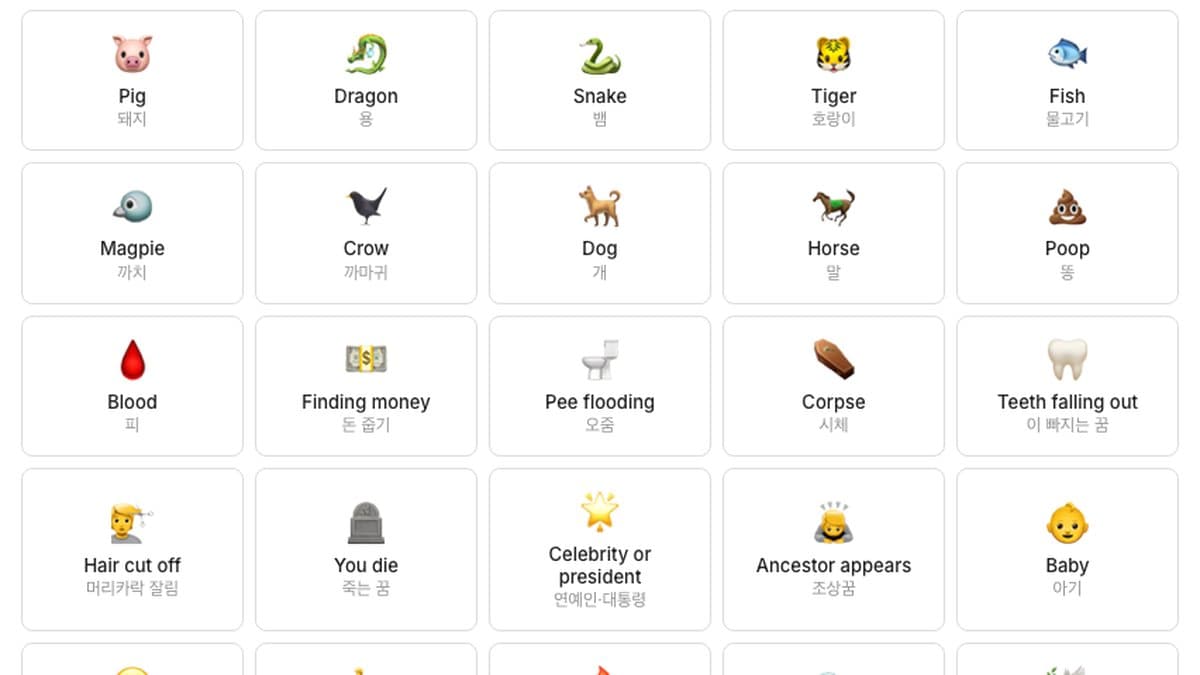
We built a free Korean dream dictionary with 30+ symbols — animals, money dreams, body dreams, nature, and the everyday stuff — each with its traditional reading, a lucky/unlucky verdict, and a completely unscientific "lotto meter." No sign-up, works in your browser.
Kkum-haemong is folk tradition, not prediction — this article and our dream dictionary are cultural entertainment, not advice. Interpretations vary by region, family, and interpreter; we've followed the most commonly cited readings.