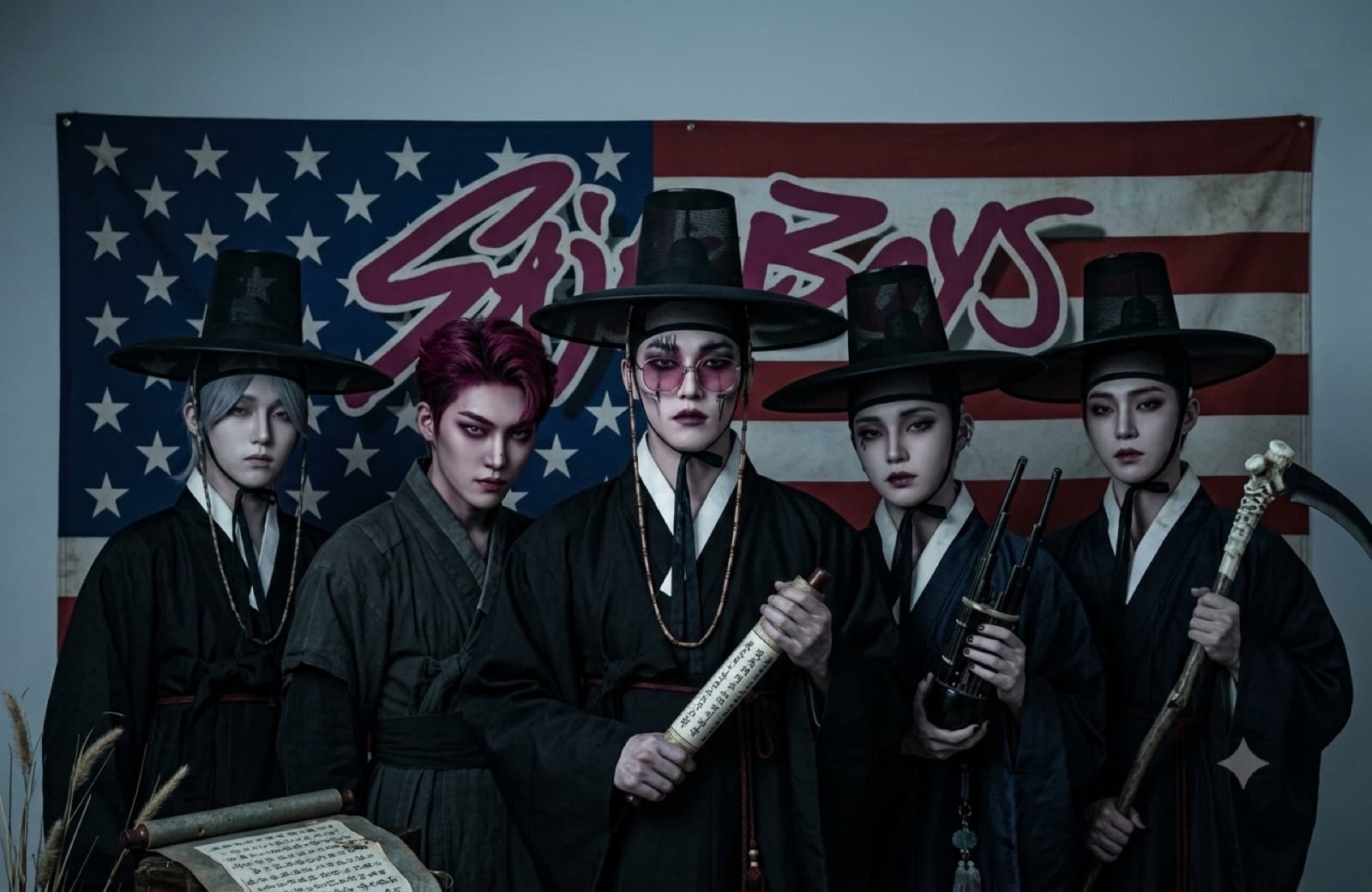
The single most talked-about moment in KPop Demon Hunters is the third-act reveal: the Saja Boys — the film's impossibly charming rival boy band — drop the pastel idol styling and perform "Your Idol" in floor-length black hanbok, wide-brimmed black hats, and corpse-pale faces. Global audiences knew they were looking at something specifically Korean. Most just didn't know what.
The answer is the jeoseung saja (저승사자) — literally "messenger of the afterlife," Korea's equivalent of the grim reaper. And the real history behind that image is a better story than you'd expect: parts of it are centuries old, and one crucial part was invented for television in 1980.
Korea's reaper is a civil servant, not a monster
In Korean tradition, the jeoseung saja isn't a scythe-swinging horror. He's an escort — a courteous official of the underworld whose job is to guide the newly dead through the difficult journey to the afterlife, and he originally appeared in shamanic rituals dressed as a military officer in armor (The Korea Herald).
Two details make the folklore vivid. First, reapers traditionally travel as a trio — which is why funeral custom called for preparing three bowls of rice, three pairs of straw shoes, and three sets of utensils as offerings. Second, you were expected to treat them well. As folklore scholar Kim Deok-mook told the Korea Herald, mistreating the reaper could bring misfortune to the deceased — so families received death's messengers as honored guests.
A five-member idol group of afterlife messengers who charm their audience before collecting their souls, in other words, is not a loose metaphor. It's the folklore, upgraded with choreography. Fittingly, "saja" both names the messenger and lets the film wink at "lion" (사자) — a homonym Korean viewers caught immediately.
Plot twist: the black robes are from 1980
Here's the detail that surprises even Koreans. The "traditional" look the Saja Boys wear — jet-black hanbok, black gat (the wide-brimmed horsehair hat), deathly pale face — isn't ancient. Joseon-era paintings depicted the reaper in bright red official armor.
The black-robed version was created for a June 1980 episode of a KBS television series. The producer, Choi Sang-shik, explained the logic plainly: they wanted a distinctly Korean image of death, so they dressed the reaper in black and contrasted it with a pale face and dark lips (The Korea Herald). The image stuck so completely that within a generation it became the tradition.
Then 2016's megahit drama Guardian: The Lonely and Great God (Goblin) modernized it again — Lee Dong-wook's reaper traded the hanbok for tailored black suits and a fedora. So when the Saja Boys morph from polished idols back into gat-and-hanbok reapers, the film is actually reversing four decades of pop-culture evolution — returning the reaper to a "tradition" that television built.
How the Saja Boys were designed
Director Maggie Kang has said the villains were the starting point, not an afterthought: "I always knew I wanted to feature the Jeoseung Saja in the movie as the villains, but that idea became even more exciting once K-pop was added in and they could also be idols" (Geeks OUT interview). Co-director Chris Appelhans confirmed the third-act look is based directly on the jeoseung saja of Korean mythology, filtered through high fashion.
As a group, the Saja Boys pull from the real K-pop canon — reporting has cited BTS, BIGBANG, Tomorrow X Together, Stray Kids, ATEEZ, and Monsta X among the references (Wikipedia's production overview).
The real faces behind Jinu
And the leader? Director Maggie Kang said Jinu's visuals drew on Cha Eun-woo (Star News, Korean) — the ASTRO member and True Beauty actor whose "face genius" nickname made him shorthand in Korea for an almost unreal handsomeness. Production coverage also names actor Nam Joo-hyuk (Twenty-Five Twenty-One, Start-Up), the model-turned-actor, as a reference for the character.
Jinu's voice completes the trifecta: he's played by Ahn Hyo-seop (Business Proposal), the Korean-Canadian actor whose bilingual background made him a natural fit for the English-language lead (Weverse Magazine, Korean).
So the character international fans fell for is a composite of three of Korea's most beloved leading men — which explains a lot about the internet's reaction.
Why this works (our take)
The Saja Boys hit differently than a generic "evil boy band" would because every layer is load-bearing: the folklore gives the villains actual mythological stakes, the 1980-TV-to-Goblin-to-KDH lineage gives Korean viewers an in-joke, and the real-actor references give the fandom faces to map onto. "Your Idol" topping Spotify's US daily chart — with the soundtrack debuting in the Billboard 200's top ten (The Korea Herald) — suggests global audiences don't need the references explained to feel that density.
It's the same pattern we keep seeing across Korean exports (the Anua collab's gat keyring is literally this folklore turned into merch): specificity travels better than translation.
This article is independent editorial. Character design attributions reflect director interviews and production reporting linked above.