Meet someone new in Korea and the introductions run: name, roughly how old you are — and, with startling reliability, "MBTI가 뭐예요?" What's your MBTI? The Myers-Briggs Type Indicator, a personality framework built in mid-century America and treated with polite skepticism by most psychologists, has achieved something in Korea it never managed anywhere else: it became social infrastructure.
Koreans put the four letters in dating profiles and social media bios. Idols list them like blood types (which, incidentally, were the previous personality fad). Brands run MBTI-targeted marketing campaigns. And in one famously controversial case, a café's job posting screened applicants by type — which triggered a national debate about where the game stops being a game.
Here's how it got this big, how to play along, and what it tells you about Korean social culture.
How it took over
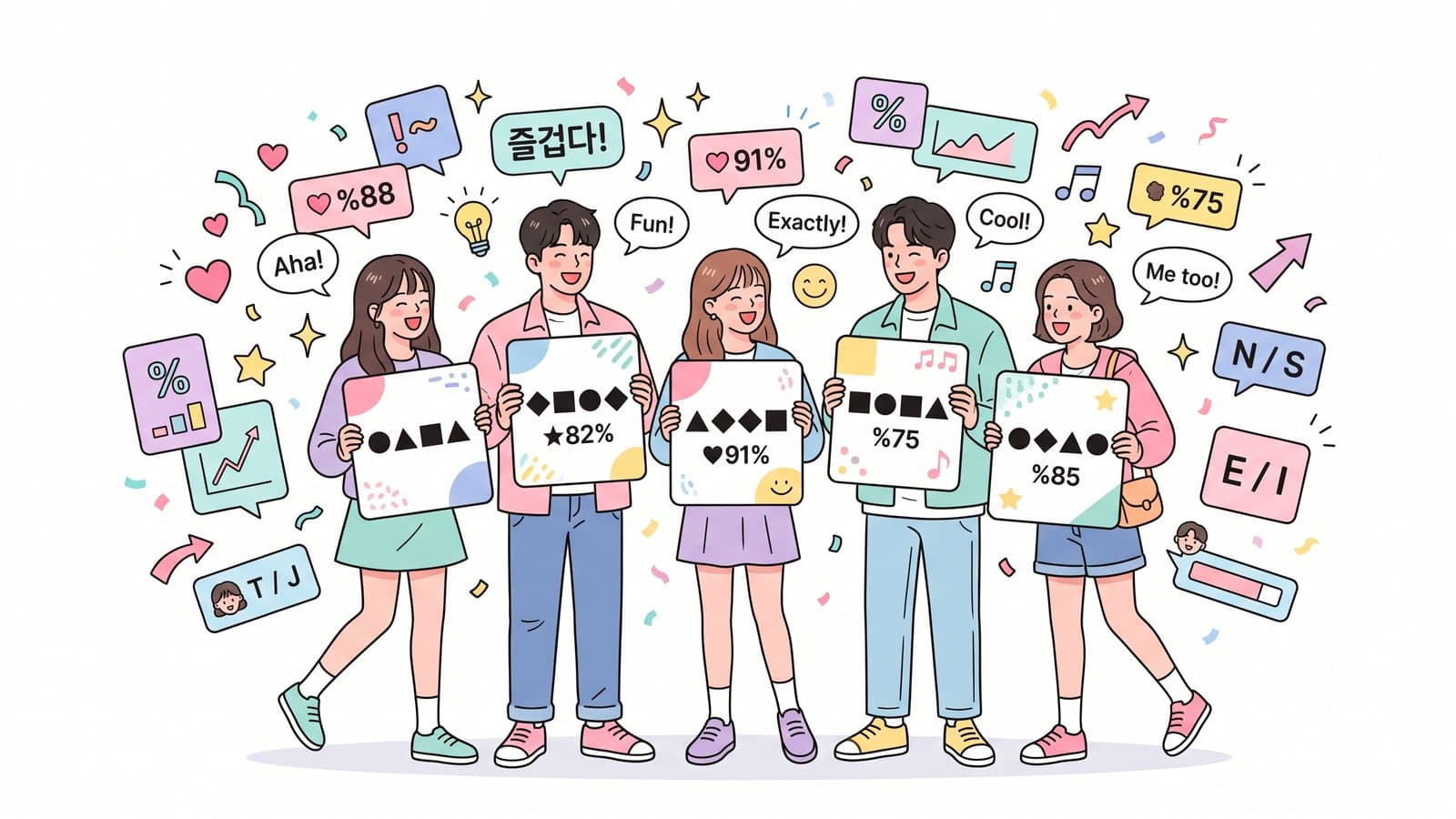
MBTI had circulated in Korea for decades (corporate training, school counseling), but the tipping point was the pandemic: stuck at home in 2020, Koreans binged free online personality tests, and comedian Kang Yu-mi's YouTube sketch series Yumi's MBTI turned the sixteen types into recognizable comic characters. By the time normal social life resumed, the framework had embedded itself into how young Koreans open conversations.
The timing wasn't random. MBTI arrived as the MZ generation's answer to a very Korean need: a fast, low-stakes way to map a new person — where older generations might have sorted people by hometown, school, or zodiac, four letters do the job in seconds and feel more personal, because you chose them by answering questions about yourself.
The vocabulary you'll actually hear
- "너 T야?" ("Are you a T?") — the meme that defines the current era. Born from a YouTube comedy sketch, it's what you say when someone responds to your emotional moment with logistics instead of sympathy. Tell a friend you failed an exam, get "which questions did you miss?" back, and the correct response is 너 T야? It's teasing, not clinical — the T/F axis became Korea's shorthand for the empathy-versus-analysis divide.
- E and I function as the social battery axis: entire meetup formats and even marketing campaigns get labeled "for I's" (introvert-friendly).
- MBTI 궁합 (compatibility) — type-pairing charts for friendships and couples circulate endlessly, treated with exactly the same half-serious energy as traditional marriage compatibility readings.
The saju connection (this is the real story)
If MBTI-as-social-ritual seems baffling, here's the decoder: Korea already had this culture — MBTI just gave it a new interface. As we covered in our guide to saju and fortune culture, Koreans have consulted birth-chart readings for life decisions and gunghap (relationship compatibility) for centuries — a socially normalized, half-serious, half-sincere practice of self-analysis and matching.
MBTI slots into the same cultural groove almost perfectly: a typed identity you receive, compatibility logic, a shared vocabulary for discussing personality — but self-serve, free, secular, and shareable. It's saju with a progress bar. That's why the question feels natural in Korea and intrusive elsewhere: the slot for it already existed. (Plenty of Koreans enjoy both — a saju café date and an MBTI meme exchange are not in conflict.)
The honest caveats
Two things Koreans themselves say, loudly:
- The science is thin. Psychologists have long noted MBTI's limited test-retest reliability and its either/or binaries; most Koreans using it know it's closer to a horoscope than a diagnosis, and treat results accordingly. The fun is the shared language, not the psychometrics.
- It has real-world creep. The hiring case above became a controversy precisely because the public felt a line was crossed — reported cases of job postings referencing MBTI drew criticism for pseudoscientific screening. When four letters move from party talk to gatekeeping, Korean opinion turns sharply critical.
Used as intended — social lubricant — it's harmless and genuinely useful; that's the register to engage it in.
Visitor's playbook
- Know your four letters before you land. Any free online test works. Not knowing your MBTI in a young Korean social setting is like showing up without a name.
- It's an invitation, not an interrogation — answering "ENFP" and asking theirs back is a complete, successful social exchange. Riff on stereotypes lightly and you're in.
- Deploy "너 T야?" correctly (at a friend who answers feelings with facts) and you will get the delighted reaction of a foreigner who clearly gets it.
- Don't over-believe it. Matching the local register — half-serious, self-aware — is the whole game.
The bigger picture
Korea's MBTI love isn't credulity — it's the same cultural engine that keeps saju cafés and compatibility charts alive: a society that moves fast, meets constantly, and likes structured ways to talk about the self. A 1940s American questionnaire just happened to fit the socket. If you want to understand how Korea socializes, four letters are honestly a better starting point than any guidebook chapter — and now you know why everyone keeps asking.
This article is independent editorial by Seoul Glow. MBTI's scientific validity is debated among psychologists; this piece describes cultural usage, not psychological advice. Meme origins and controversy details reflect Korean media reporting.