Look closely at any hanbok in a palace photo and you'll spot it: a slender ornament hanging from the jacket tie, ending in a silk tassel that swings when the wearer moves. That's a norigae (노리개) — and while every visitor to Seoul photographs one, almost nobody knows you can spend an afternoon making your own, for less than the price of lunch.
We'd put it near the top of the list of Seoul experiences that punch above their weight: two hours, a real traditional skill, and a souvenir that isn't mass-produced. Here's how it works.
What a norigae actually is
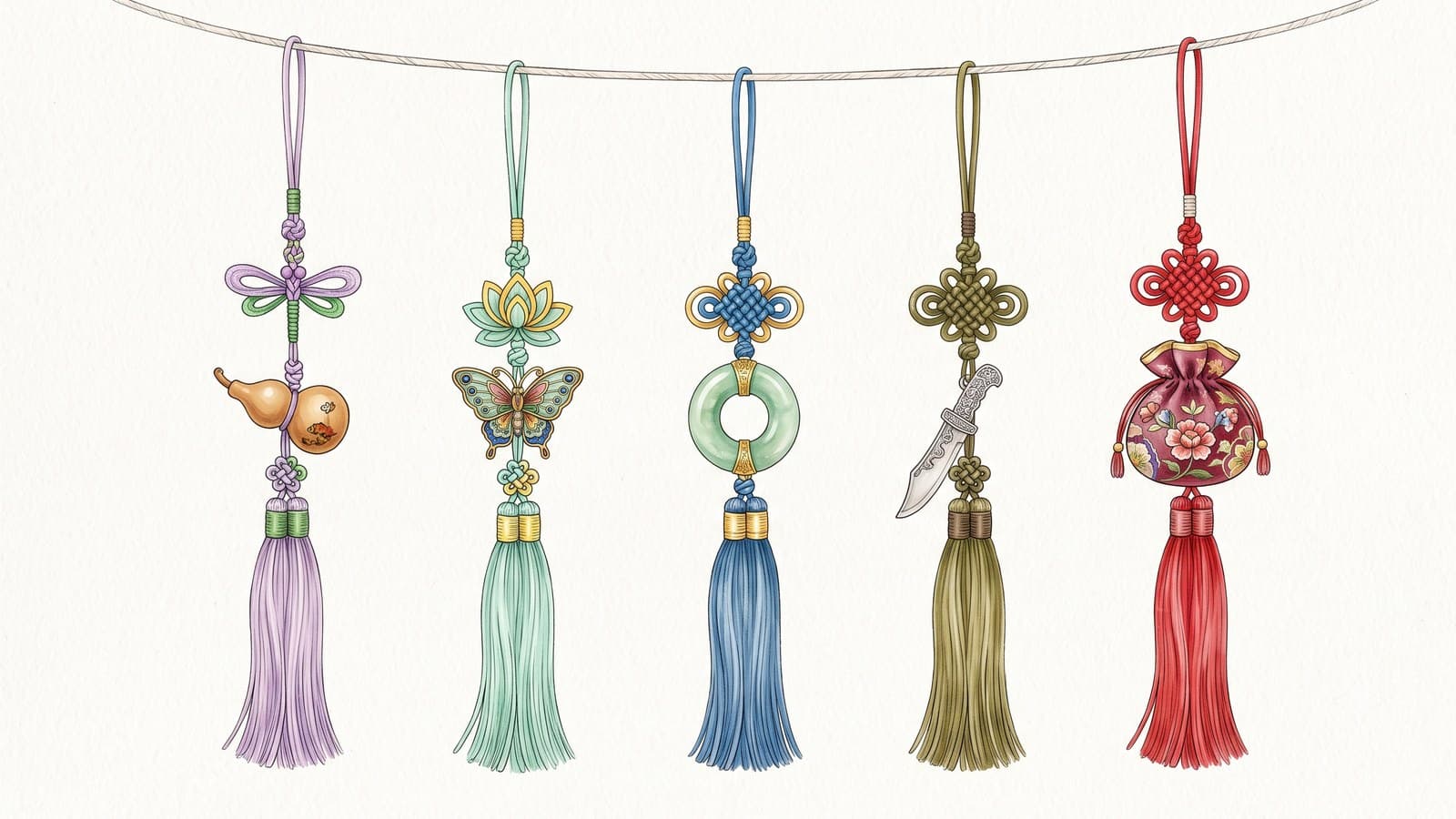
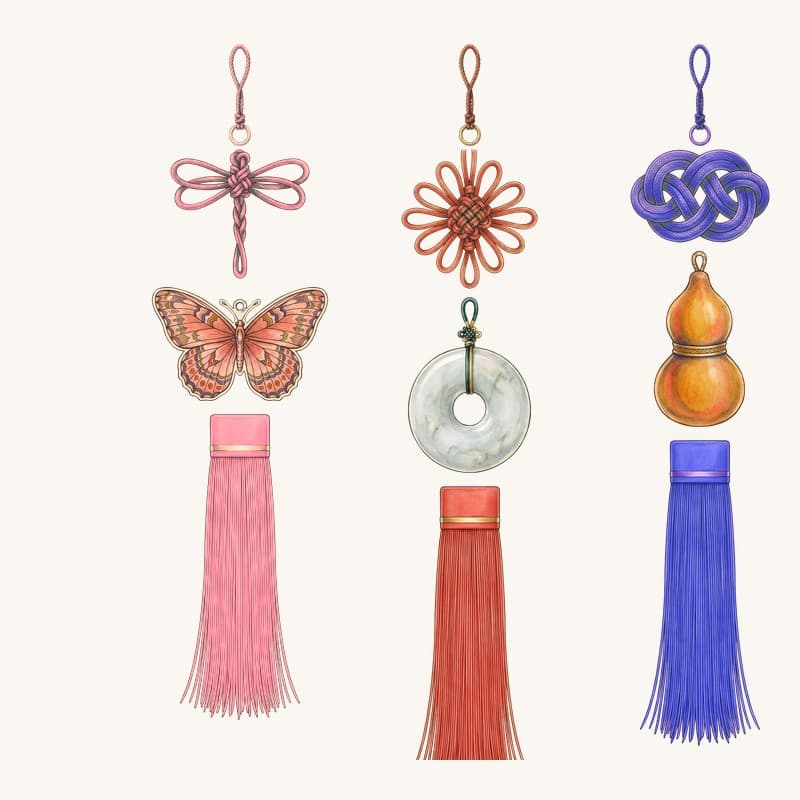
A norigae is a pendant accessory hung from the goreum (jacket ties) or waist of a woman's hanbok. Structurally it has three parts: a decorative main ornament (jade, silver, amber, or embroidered cloth), the knotwork connecting everything, and the tassel (술) at the bottom that gives it its motion.
Historically, norigae were worn across social classes in the Joseon dynasty — from royal court women to commoners — with the materials signaling the wearer's status. The motifs are a wish vocabulary: bats and gourds for good fortune, peppers and eggplants for sons, butterflies for happiness, longevity symbols for exactly that. A norigae wasn't only decoration; it was a small, wearable prayer.
The knotwork is its own art form. Maedeup (매듭), Korean decorative knotting, is a traditional craft in which a single cord is looped into symmetrical, named knots — the dorae (double connection) knot, the gukhwa (chrysanthemum) knot, the dragonfly knot — each with its own meaning. Making a norigae is, in practice, learning maedeup.
What a class actually involves
A typical beginner session runs about 1.5–2 hours and follows the same arc:
- A short history — what norigae were for, who wore them, what the motifs mean. Usually 10–15 minutes with samples to handle.
- Learning one or two knots. Beginners almost always start with the dorae knot (the basic connector) and then the gukhwa — the chrysanthemum knot that looks impossibly intricate and turns out to be one repeated loop. Expect to undo it three times. That's normal; instructors expect it.
- Assembly — threading your knotted cord through the main ornament, attaching the tassel, and trimming it.
- Taking it home. Many modern classes make a norigae-style keychain or bag charm rather than a full hanbok pendant, which is honestly the more useful object for most travelers.
No Korean is needed at the tourist-facing workshops; the craft is taught by demonstration and hands-on correction.
Where to make one in Seoul
- Dong-Lim Knot Museum (동림매듭공방), Bukchon — a small museum-workshop dedicated to maedeup, in the hanok neighborhood. Its one-day class teaches a chrysanthemum-knot bracelet, dragonfly knot, or strap for around ₩10,000–12,000, making it the most traditional and most affordable option. Pairs naturally with a Bukchon walk.
- Understand Avenue, Seoul Forest — a knot workshop with English-speaking staff and a norigae-keychain format, bookable online. Good for the Seongsu-side of your itinerary.
- Leesle (Hongdae / Insadong) — a modern hanbok brand that runs a norigae-making experience in a contemporary-fashion setting; the design-forward option.
- Insadong — if you'd rather buy than make, the main street and the Ssamziegil courtyard complex are the reliable places for handmade norigae by working artisans.
Prices and class formats change, so book through each venue's current listing rather than assuming last season's details.
The honest take
A two-hour class will not make you a maedeup artisan — the professionals train for years, and the museum-grade norigae you'll see in Bukchon display cases are a different universe from a first attempt. What you will leave with is the ability to tie two real Korean knots, a physical object you made, and a completely changed way of seeing hanbok: the next palace photo you take, you'll be looking at the knots.
Two practical notes. First, the traditional pendant format only really "works" on hanbok, which is why the keychain/bag-charm versions exist — pick the format you'll actually use. Second, if you're planning a hanbok rental day at the palaces (see our free museums and palace guide for the entry perks), doing the norigae class first means you can wear your own creation in the photos, which is the whole flex.
Make one right now (digitally)
Before you book a class, play with the combinations: our norigae builder lets you pick from five ornaments, three knots, and six silk colors, then reads the "fortune" of your combination based on the traditional motif meanings above. Save the image and bring it to the workshop as your design brief.
Pair it with
Bukchon (Dong-Lim) → Gyeongbokgung palace → the free National Palace and Folk Museums at its edges makes a coherent "Joseon craft" day. Or, for the language-curious, the Understand Avenue workshop sits near the cafés of Seoul Forest — a good place to practice the Hangul you learned last weekend on the menus.
This article is independent editorial by Seoul Glow. We have no affiliation with any workshop or brand mentioned; prices and formats reflect public listings as of August 2026 and may change.